Science
Endangered southern resident orca J31 seen carrying a dead newborn calf off Vancouver Island
The 31-year-old whale, who has lost several calves before, was spotted near Sombrio Point on Oct. 3. Researchers say the loss underlines long-standing reproductive difficulties in a population of roughly 75 whales that depends on chinook salmon.
Published: October 8, 2026 · Updated: October 8, 2026 · 3 min read
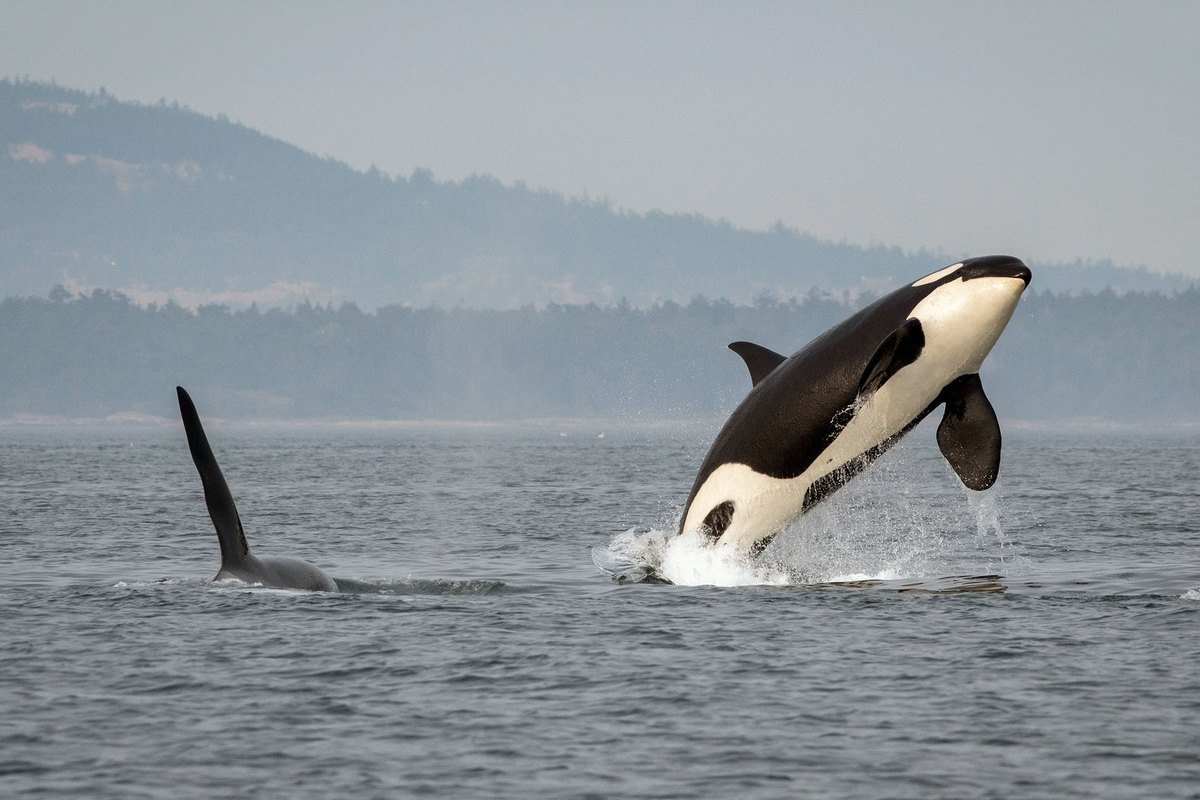
A critically endangered southern resident killer whale with a long history of failed pregnancies has been seen carrying a dead newborn calf off southern Vancouver Island, the Center for Whale Research said in a statement republished by theOrcasonian. Centre researcher Mark Malleson encountered the whale, known as J31, and her immediate family on Oct. 3 near Sombrio Point in the Strait of Juan de Fuca, about 70 kilometres west of Victoria as the crow flies, CBC News reported.
It is unclear whether the newborn was male or female, whether it had been carried to full term, and whether it died after birth or was stillborn, the Friday Harbor, Wash.-based centre said. “The loss is particularly significant given J31’s reproductive history and the continuing challenge of successful reproduction within the critically endangered Southern Resident killer whale population,” the statement said.
J31, also known as Tsuchi, was born in 1995. She had four miscarriages between 2009 and 2013 and was seen carrying a dead calf once before, in 2016, the Times Colonist reported. Her only surviving offspring is a daughter, J56, also known as Tofino, born in 2019. Seattle public radio station KUOW reported that J31 has lost at least eight calves before or just after birth. “She’s kind of the poster child, if you will, for the pregnancy failure issue in this population,” whale researcher Deborah Giles of the nonprofit SeaDoc Society said, according to KUOW.
It is the fifth time in the past decade that a female from the population has been found pushing and carrying a dead calf in the Salish Sea, according to the Times Colonist. In 2018, J35, also known as Tahlequah, carried her dead calf for 17 days; she lost another calf in January 2025 and carried it for 11 days. In September 2025, the centre documented J36, or Alki, carrying a dead calf with its umbilical cord still attached in Rosario Strait. Less than one-third of pregnancies among the southern residents result in a young whale living to its first birthday, KUOW reported. An orca pregnancy typically lasts 17 months.
Population counts in recent reports vary slightly. The Times Colonist put the population at 75 whales in J, K and L pods, with J Pod the largest at 27 members, while KUOW cited 76, down from 88 in 2005. CBC said there were about 73 whales in 2024.
“Although the cause of this calf’s death is not known, it occurs against a backdrop of longstanding reproductive difficulties within the population,” the Center for Whale Research said. “For a population as small as the southern residents, the successful birth and survival of every calf matters.” The centre said one of the most significant limits on recovery is the availability of the large, nutritionally rich chinook salmon the whales depend on. “It’s when a female is not getting enough to eat that the body’s natural response is to abort that pregnancy,” Giles said, according to KUOW. The whales also face water pollution, ship noise and inbreeding, the station reported, and in summer they rely mainly on chinook returning to B.C.’s Fraser River.
In Canada, southern residents were listed as endangered under the Species at Risk Act in 2003, and federal imminent-threat assessments in 2018 and 2024 found they face imminent threats to survival and recovery, according to Fisheries and Oceans Canada. The department lists three primary threats: reduced prey availability and accessibility, acoustic and physical disturbance, and contaminants. Its 2026 measures include salmon fishing closures from Aug. 1 to Oct. 31 in parts of the Juan de Fuca Strait and from July 15 to Oct. 31 around Swiftsure Bank, and an interim order requiring vessels to stay 1,000 metres from southern residents in southern B.C. coastal waters between Campbell River and just north of Ucluelet until May 31, 2027. Ottawa has also proposed amending the Marine Mammal Regulations to set a 1,000-metre approach distance for southern residents.
An international panel of researchers has urged bolder steps, including restrictions on fisheries that target chinook returning in spring and early summer to the Fraser River and other spawning grounds, so the orcas have adequate food year-round, KUOW reported.
This article reports wildlife science for general information only and is not medical advice.
Sources: Center for Whale Research statement via theOrcasonian (Oct. 7, 2026); CBC News / The Canadian Press (Oct. 7, 2026); Times Colonist (Oct. 7, 2026); KUOW (Oct. 6, 2026); Fisheries and Oceans Canada: 2026 management measures to protect Southern Resident killer whales.
Sources
- Center for Whale Research via theOrcasonian · organization
- CBC News / The Canadian Press · news
- Times Colonist · news
- KUOW · news
- Fisheries and Oceans Canada · government
Newsletter
News. Context. What matters.
One essential briefing, written for people who would rather understand the story than scroll it.
Unsubscribe anytime. We don’t sell addresses.
Recommended
Science
Climate-driven wildfires could cost Canada more than $2 trillion this century unless warming is held to 2 C, SFU study finds
A Simon Fraser University model puts the annual cost of climate-change-driven fire impacts at $43 billion by the end of the century in a 3-4 C world. Its lead author says the estimate is likely conservative because it leaves out health, evacuation and infrastructure costs.

Science
Chemistry Nobel goes to Henri Kagan and Kenso Soai for showing how reactions can favour one mirror-image molecule
The French and Japanese chemists cracked a century-old puzzle about why life’s molecules come in only one “hand,” work the Nobel committee says has been decisive for chemists who design reactions to make medicines.
Science
HPV vaccine still protects women living with HIV up to nine years later, Canadian study finds
A UBC-led study of 293 women at 14 clinics across Canada, published in The Lancet HIV, found very low rates of vaccine-type HPV infection and no serious precancerous changes from those strains among women who got all three doses.