Science
Florence physicists entangle a levitating glass speck with light at room temperature
A Science paper shows stationary quantum links between a 100-nanometre silica nanosphere’s motion and a travelling optical field — no cryogenics required.
Published: October 4, 2026 · Updated: October 4, 2026 · 1 min read
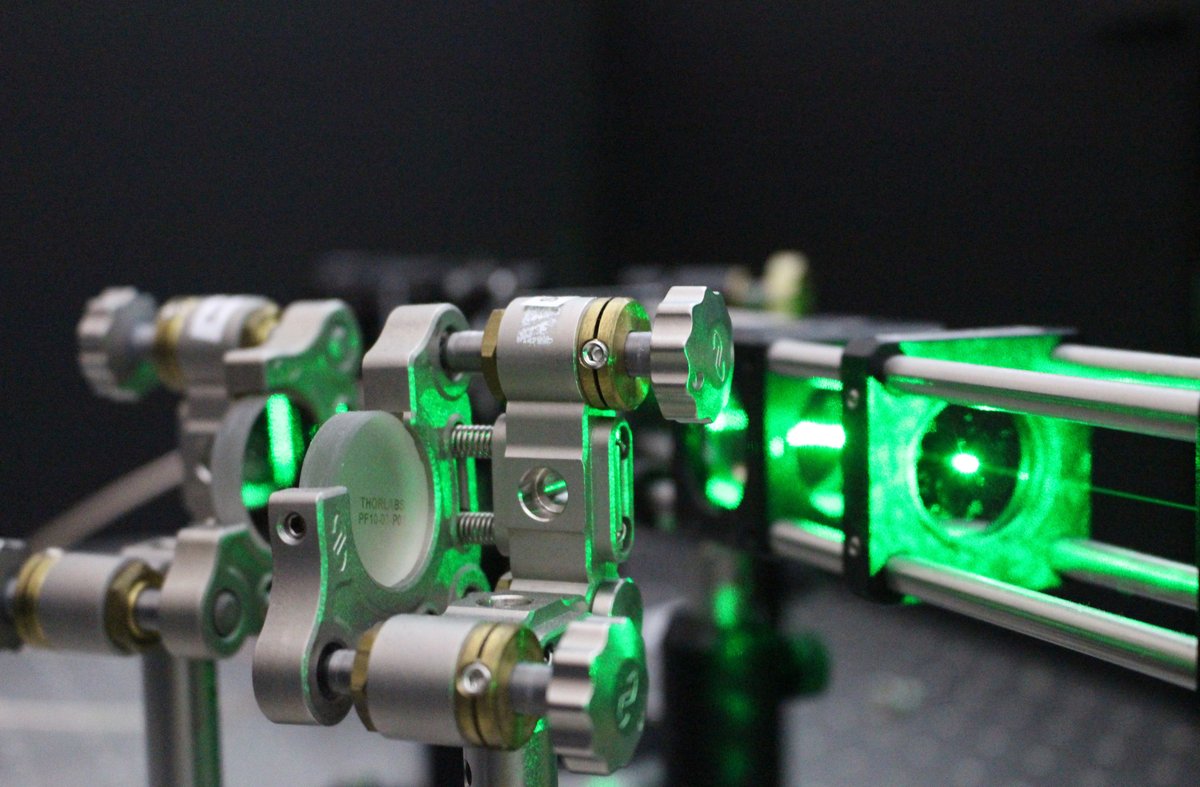
Physicists at the University of Florence and Italy’s National Institute of Optics (CNR-INO) say they have generated stationary quantum entanglement between the centre-of-mass motion of a levitated glass nanosphere and light that leaves the experiment — all while the laboratory stays at room temperature.
The team, led by Francesco Marin with co-authors Quentin Deplano, Antonio Pontin and Francesco Marino, trapped a roughly 100-nanometre silica sphere — tens of millions of atoms — in an optical tweezer inside a near-vacuum cavity, ScienceAlert and a CNR release reported around Oct. 1–2. A red-detuned laser cooled and stabilised the bead’s tiny oscillations toward the quantum regime; a blue-detuned companion created the correlations that link the sphere’s position and momentum to the light’s amplitude and phase “quadratures.” Measurements of the outgoing field drove a separability parameter to 0.918 ± 0.029, below the classical threshold of 1, confirming entanglement that persists in propagating light rather than only in cavity-trapped modes.
That travelling field is the practical prize. Marin told ScienceAlert that cavity-bound light is hard to use as a quantum resource elsewhere, whereas light that exits can, in principle, feed networks, remote measurements or other devices. The work, published in Science (doi: 10.1126/science.aeh1375) and mirrored on arXiv, did not cryogenically cool the apparatus; levitation, high vacuum and optical cooling alone kept the mechanical degree of freedom cold enough for quantum correlations to form before environmental heating erased them. CNR-INO’s Francesco Marino called the result a step toward using massive room-temperature oscillators as quantum memories that store and release information carried by light.
Canadian labs working on quantum networks and sensing will watch the next milestones: stronger, dynamically controlled entanglement and coupling several nanospheres into larger systems. The Florence–CNR experiment does not claim a quantum computer; it claims a cleaner interface between a macroscopic mechanical object and a flying optical channel — a building block, not a finished machine.
Sources: ScienceAlert; CNR / Università di Firenze; arXiv — Stationary entanglement of a levitated oscillator with an optical field; INSPIRE-HEP record.
Sources
- ScienceAlert · other
- CNR / Università di Firenze · other
- arXiv · other
- INSPIRE-HEP · other
Newsletter
News. Context. What matters.
One essential briefing, written for people who would rather understand the story than scroll it.
Unsubscribe anytime. We don’t sell addresses.
Recommended
Science
ETH–PSI ‘atomic cannon’ fires cold muonium beam toward Einstein gravity test
A Nature Physics breakthrough produces an intense, near-parallel beam of exotic atoms so researchers can ask whether second-generation matter falls like ordinary matter.
Science
Health Canada flags possible weight-loss risk for under-6s on ADHD stimulants
Safety review of amphetamine and methylphenidate products will push monograph warnings for off-label preschool use; drugs remain authorized from age six.
Science
Health Canada approves Dawnzera (donidalorsen) to prevent hereditary angioedema attacks
RNA-targeted injection for ages 12+ cut monthly attack rates by 81% vs placebo in Phase 3; Celystra seeking public reimbursement as commercial launch nears.