Canada
Meta's $13-billion bet on Alberta: what it really means for your power bill
Thousands of construction jobs, hundreds of permanent ones, and a billion-dollar question about who pays for the power. An honest look at the province's biggest tech deal.
Published: October 13, 2026 · Updated: October 13, 2026 · 4 min read
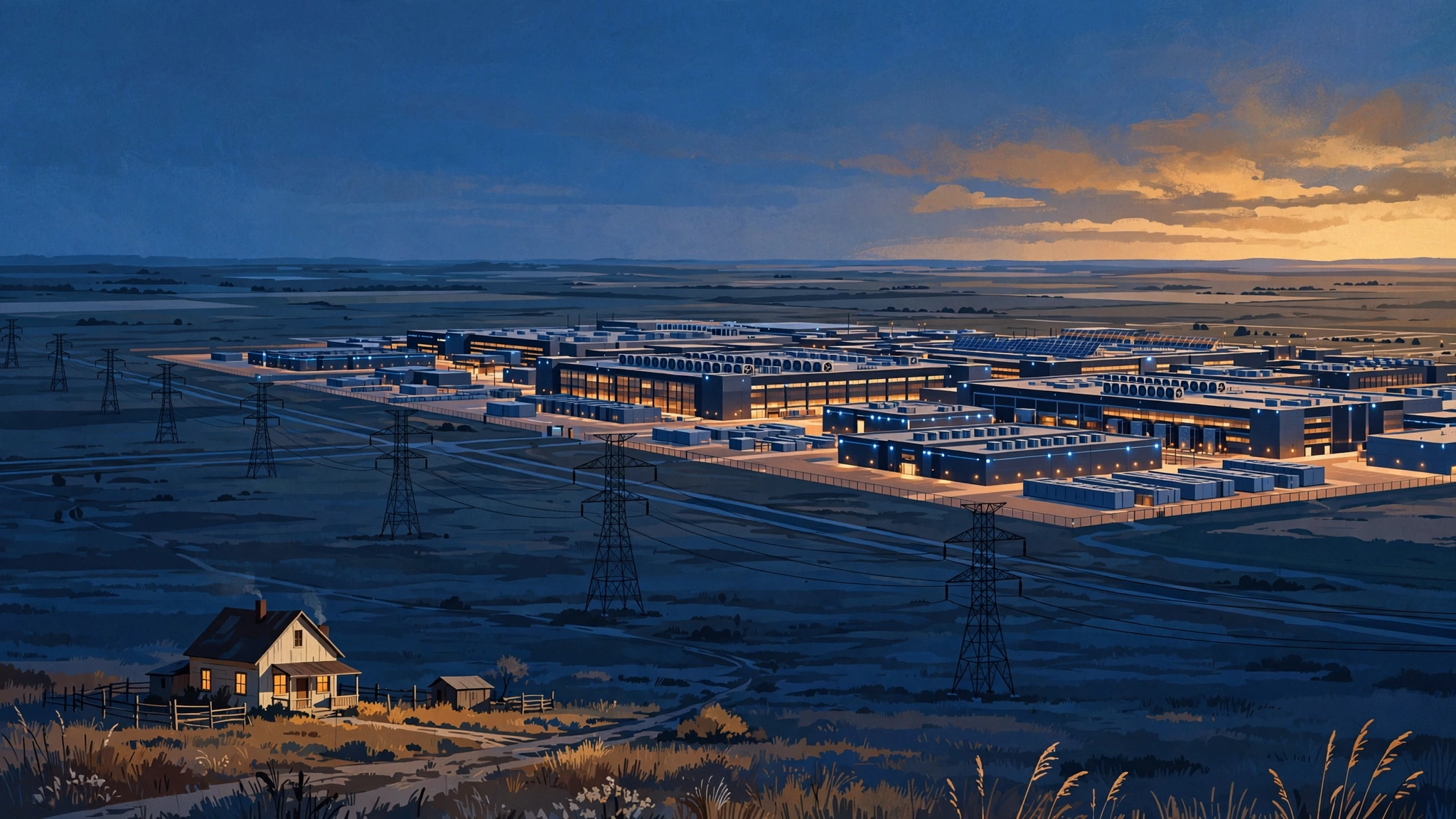
In early July, Premier Danielle Smith stood in Calgary and announced what she called "one of the largest private sector investments in Canadian history": Meta will spend more than C$13 billion building a one-gigawatt AI data center in Sturgeon County, about 35 kilometres northeast of Edmonton — the company's first in Canada and, according to AP reporting, its largest outside the United States. The numbers are enormous. The questions they raise are bigger.
Start with what the deal actually is. The campus will draw 1,000 megawatts at launch — roughly what it takes to power 800,000 homes — and is designed to scale to 1.8 gigawatts. Meta promises up to 3,000 construction jobs at peak and more than 300 permanent operational positions. A C$4.6-billion natural-gas plant, the Greenlight Electricity Centre, is being built to feed it: 932 megawatts, burning about 150 million cubic feet of gas a day, targeted for the second half of 2030. Meta is also putting about C$60 million into local roads and water infrastructure. The province, for its part, expects roughly C$250 million a year in royalties, taxes, levies and fees.
Now the honest part — beginning with the question Albertans keep asking: will this raise my power bill? The Pembina Institute, a clean-energy think tank, calculates the facility could add $267 to $462 a year to a typical household bill by 2031. Its logic is about timing: the data center is expected online around 2029, roughly a year before its dedicated gas plant, meaning a gigawatt of new demand — about a tenth of Alberta's generating capacity — lands on the wholesale market first. The province and Meta reject the math. Meta spokesperson Julia Perreira called the report "based on hypotheticals and assumptions," saying Meta "pays the full cost of energy upgrades and electricity that our Sturgeon County data centre will use." The government's line is "no subsidies, no discounted electricity and no taxpayer backstops," and it claims the arrangement will actually cut transmission costs for ratepayers by up to 6 per cent.
Independent economists land somewhere uncomfortable in the middle. University of Calgary economist Kent Fellows warned that if new generation doesn't arrive with the load, wholesale prices rise. Energy economist Antweiler called Pembina's roughly 15 per cent price-increase estimate "plausible," with the real uncertainty being "whether it's 10 per cent or 15 per cent or even 25 per cent." The grid operator itself says additional data-center demand is expected to raise wholesale prices, and EPCOR warned the regulator of "material, and perhaps unintended consequences, to the electricity price signal with anticipated negative impacts to Alberta consumers." This is the thing to watch, in a province where power bills are already a sore point — and the data-center queue now tops 20,600 megawatts of requests against a provincial peak of about 13,000. Meta is the first. It will not be the last.
Then there's jobs. Three thousand construction jobs is real money for tradespeople — electricians, pipefitters, crane operators — for about three years. But the permanent footprint is just over 300 positions at a $13-billion facility: roughly $43 million of investment per permanent job. As one industry commentator put it, data centers "don't create a lot of jobs" once built, which is why the pitch leans on property taxes instead. That's not an argument against the project — it's an argument for honest expectations. The economic case rests on the supply chain, the tax base and whatever comes next, not the headcount.
On the environment, the gap between the marketing and the physics is worth stating plainly. Meta says it will match the facility's electricity use with "100 percent clean and renewable energy" — but the physical electrons come from a gas plant, with the clean claim met through renewable energy certificates. Greenpeace Canada's Keith Stewart calls that an "accounting game." The Pembina Institute calculates the gas plant will emit about 3 million tonnes of greenhouse gases a year — roughly a tenth to a sixth of the electricity sector's current emissions — in a province whose grid emissions intensity is already nearly five times the national average. Water, unusually, is the least controversial part: closed-loop dry cooling suited to Alberta's cold climate, with Meta saying annual water use will be less than a typical golf course.
And the subsidies question — the most contested ground of all. The government's position is absolute: "No subsidy, no grant, no discounted power, no guarantee." The counter, from Public Interest Alberta, is that the UCP's 2 per cent hardware levy on large grid-connected data centers is fully creditable against corporate income tax — "meaning taxpayers will see little to no benefit." The local property-tax treatment in Sturgeon County hasn't been disclosed. Neither side's version is the full story, and Albertans deserve the actual numbers before the shovels go deeper.
Why Alberta, though? The honest answer is that the province built the welcome mat on purpose: cold air that makes dry cooling work, natural gas at a deep discount to U.S. prices, and a "bring your own generation" framework — legislated in late 2025 — that lets developers build dedicated power instead of queueing for the shared grid. Meta's Canada policy head said Alberta "set a precedent in Canada and created a regulatory environment capable of attracting major hyperscalers." That's a genuine competitive win. It's also worth naming what it is: a diversification story powered by burning more of the same natural gas, now being cited in the run-up to the Oct. 19 referendum.
So what should Albertans actually expect? A real construction boom, real supply-chain spending, and real tax revenue — alongside genuine, unresolved questions about power prices, the true tax treatment, and emissions. My honest take: judge this deal on three verifiable tests. One: do household power bills rise or fall by 2031? Two: what did Sturgeon County actually concede on property taxes? Three: does the gas plant arrive before the data center, or do Albertans bridge the gap? If the answers come back clean, the superlatives will have earned themselves. If not, the province will have learned what Louisiana and Utah already did — that the fine print on these deals matters more than the headline number.
What matters
What happened
Meta announced a C$13B+, 1 GW AI data center in Sturgeon County — its first in Canada — with a C$4.6B gas plant to power it.
Why it matters
It's the largest private tech investment in Alberta's history, arriving ahead of the Oct. 19 referendum — and it will test power prices, the tax base and emissions.
What we know
3,000 construction jobs promised, just over 300 permanent; the Pembina Institute estimates $267–$462/year on household bills by 2031 (disputed by Meta and the province); the physical power comes from natural gas.
What we don’t
The actual local property-tax treatment in Sturgeon County; whether household power bills rise or fall; whether the gas plant arrives before the data center opens.
What’s next
Construction over 2–3 years; data center ~2029; Greenlight gas plant H2 2030; 20,600 MW of further data-center requests queue behind it.
Sources
- Data Center Dynamics · other
- Building.ca (Smith radio show) · other
- Alberta.ca (Who Benefits) · other
- The Regional (power bill analysis) · other
- Tech Times · other
- Pixel Envy (tax analysis) · other
- · other
Danielle SmithopinionMetadata centerAlbertaSturgeon Countyelectricity prices
Newsletter
News. Context. What matters.
One essential briefing, written for people who would rather understand the story than scroll it.
Unsubscribe anytime. We don’t sell addresses.
Recommended

Canada
Ottawa tables bill to let Canadians request assisted dying in advance — and drops the mental-illness expansion
Bill C-41 would let adults diagnosed with an incurable illness that will take away their decision-making capacity consent to medical assistance in dying in advance, while the government says it will not proceed with eligibility based solely on mental illness.
Canada
Trump says a Canada tariff deal is coming 'pretty soon' — but offers no terms
At a Michigan border rally Sunday, the U.S. president predicted the trade dispute would be settled soon while repeating his claim Canada has been "ripping off" the U.S. — and Ottawa did not immediately respond.
Canada
B.C. Conservatives win majority government — and David Eby is stepping down as NDP leader
CTV News declared a Conservative majority Saturday night as interim leader Lorne Doerkson's party surged to a commanding lead, ending nine years of NDP government and giving B.C. its first Conservative government in nearly a century.