Science
CHIME telescope maps cosmic hydrogen glow on its own, opening a dark-energy shortcut
Canadian-built array near Penticton detects 21 cm signal at redshift ~1 without cross-matching galaxy surveys — a first for intensity mapping.
Published: October 4, 2026 · Updated: October 4, 2026 · 2 min read
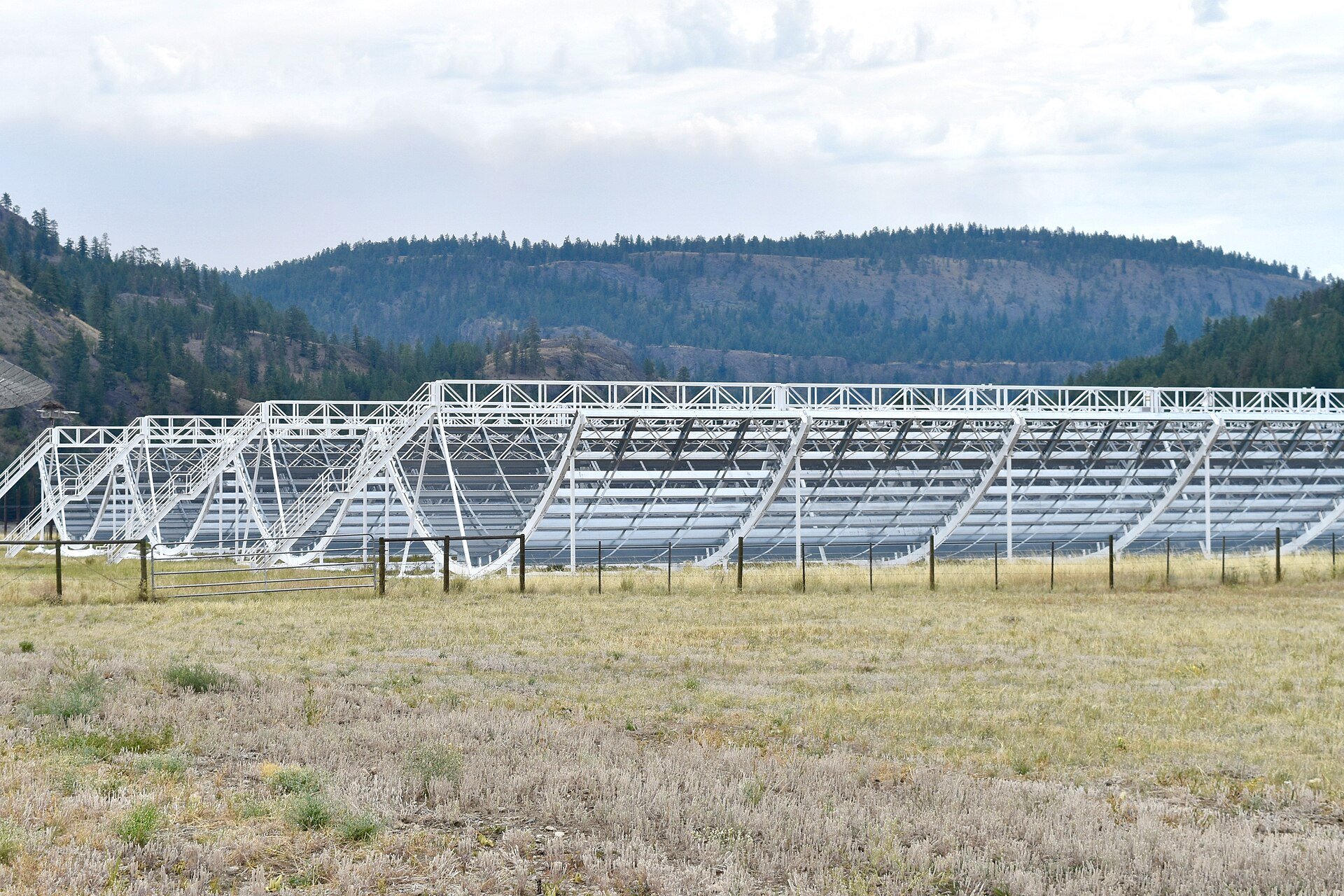
A Canadian radio telescope in the Okanagan has shown it can hear the faint glow of ancient hydrogen without leaning on anyone else’s galaxy catalogue — a milestone cosmologists have chased for more than a decade.
UBC News reported that the Canadian Hydrogen Intensity Mapping Experiment (CHIME), hosted by the National Research Council near Penticton, B.C., published its first standalone detection of the cosmological 21-centimetre signal in The Astrophysical Journal. Unlike earlier CHIME results that had to be cross-checked against optical galaxy surveys, the new analysis uses only CHIME’s own data from 94 nights in 2019, after more than a year of tests to rule out false alarms from terrestrial interference, the bright foreground sky and the instrument itself. Scienmag summarised the same breakthrough for a broader science audience.
Co-author Arnab Chakraborty of the University of Toronto described hydrogen’s radio emission as a “cosmic tracer” of how matter is spread through space. Principal investigator Mark Halpern of UBC called it “a completely new technique for probing the cosmos, delivered by an instrument that was conceived, built and funded by Canadians.” An accompanying interpretation paper, catalogued on INSPIRE-HEP and mirrored on alphaXiv, reports the auto power spectrum at redshifts about 1.01 to 1.34 with overall significance above 12σ, and notes that roughly two per cent of hydrogen was in neutral atomic form at that epoch — broadly consistent with other measurements, according to Arizona State’s Shabbir Shaikh.
The practical prize is cost and independence. Galaxy surveys map the same expansion history in fine detail but at far higher expense and only where stars have already formed. Intensity mapping averages the hydrogen glow over huge volumes, reaching further back — researchers already plan to push toward epochs when the universe was about three billion years old, using nearly seven years of CHIME observations now on disk — and testing competing dark-energy models without importing another team’s catalogue. CHIME is a pan-Canadian collaboration of UBC, McGill, the University of Toronto and the Dominion Radio Astrophysical Observatory, with North American partners including Arizona State, funded by the Canada Foundation for Innovation, NRC, NSERC and the provinces of British Columbia, Ontario and Quebec, with digital research support from the Digital Research Alliance of Canada.
This article discusses published scientific research for general information; it is not medical or health advice.
Sources: UBC News; INSPIRE-HEP / Astrophysical Journal record; Scienmag; alphaXiv preprint mirror.
Sources
- UBC News · other
- INSPIRE-HEP · other
- Scienmag · other
- alphaXiv · other
Newsletter
News. Context. What matters.
One essential briefing, written for people who would rather understand the story than scroll it.
Unsubscribe anytime. We don’t sell addresses.
Recommended
Science
Florence physicists entangle a levitating glass speck with light at room temperature
A Science paper shows stationary quantum links between a 100-nanometre silica nanosphere’s motion and a travelling optical field — no cryogenics required.
Science
ETH–PSI ‘atomic cannon’ fires cold muonium beam toward Einstein gravity test
A Nature Physics breakthrough produces an intense, near-parallel beam of exotic atoms so researchers can ask whether second-generation matter falls like ordinary matter.

Science
Health Canada flags possible weight-loss risk for under-6s on ADHD stimulants
Safety review of amphetamine and methylphenidate products will push monograph warnings for off-label preschool use; drugs remain authorized from age six.