Money
Oil just hit $110. Your gas tank is next — and the Bank of Canada is running out of good answers
Brent crude touched $110 a barrel on Friday as tankers burned in the Strait of Hormuz. Canadian drivers are about to pay for a war they didn't start — and the people who set interest rates are in a bind with no clean way out.
Published: October 18, 2026 · Updated: October 18, 2026 · 4 min read
The $110 barrel
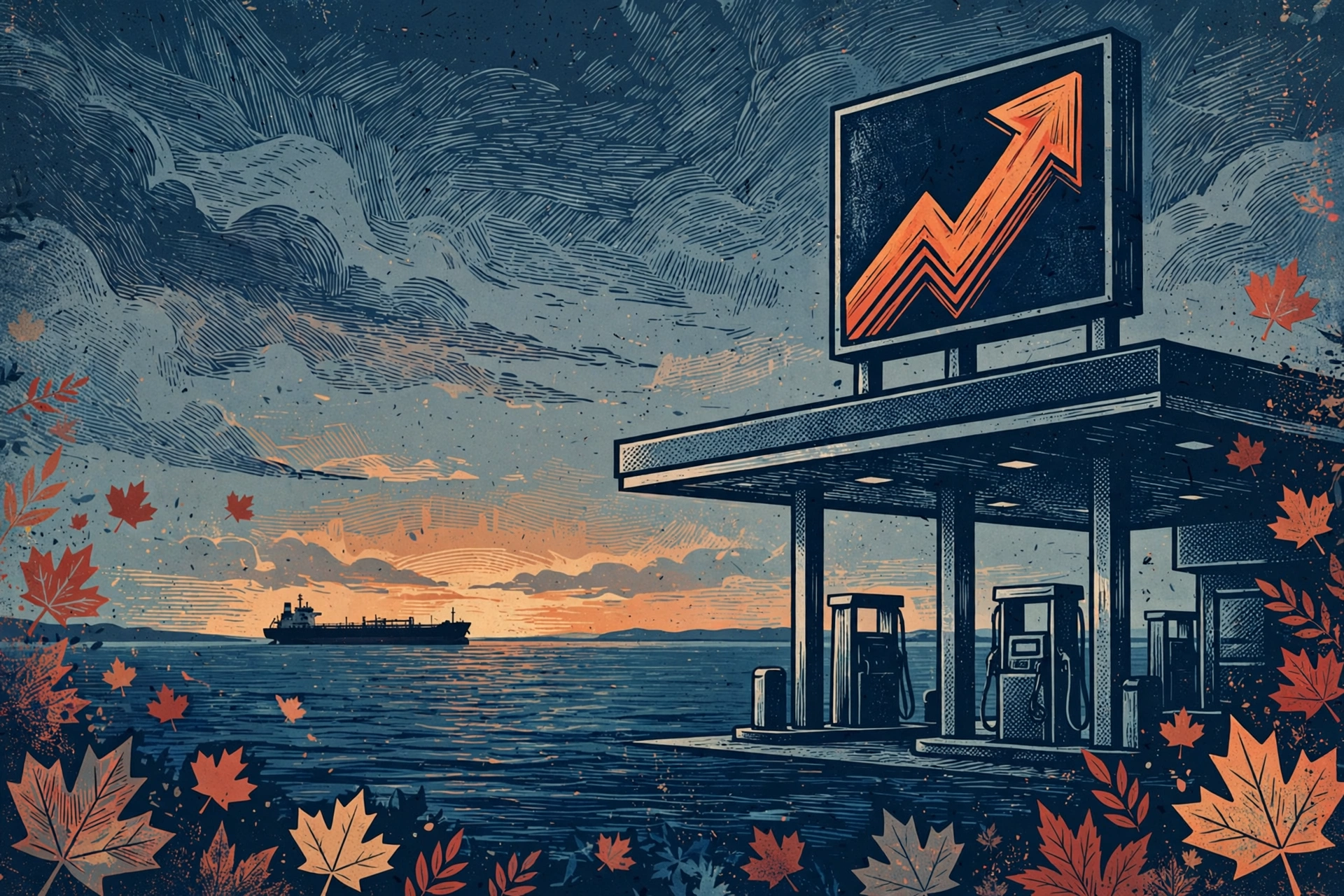
Brent crude — the global benchmark that sets the price of the gasoline in your tank — touched $110 a barrel on Friday for the first time since May, settling at $109.86, up 3.7 per cent on the day, according to CNBC's market data. U.S. West Texas Intermediate settled at $101.41, up 3.5 per cent. For the week, WTI soared more than 10 per cent and Brent gained nearly 5 per cent. On Sunday, Brent hovered near $108.82 as traders weighed fresh Ukrainian drone strikes on Russian oil facilities in St. Petersburg and more tanker attacks in the Persian Gulf, CNBC reported.
The cause is not mysterious. At least nine tankers and cargo ships have come under attack near the Strait of Hormuz since last Sunday, as Iran tries to choke oil shipments through the waterway that carries roughly a fifth of the world's seaborne oil. Two tankers struck naval mines and caught fire over the weekend, and Iran's Islamic Revolutionary Guard Corps confirmed the explosions, warning the strait remained blocked, according to Daily Post's Sunday reporting. Energy researcher Kpler's data shows crude transit through the strait collapsed from 20.8 million barrels per day on Oct. 8 to 2.9 million on Oct. 11, with the weekly average at about 70 per cent of prewar levels. Separately, Ukraine's drones hit an oil terminal in St. Petersburg on Sunday — a facility exporting about 120,000 barrels per day of refined products, per Kpler — and the UK Maritime Trade Operations centre reported two tankers attacked off Saudi Arabia's coast on Friday.
What it costs you
Here is the part that matters to Canadian wallets: pump prices follow crude, with a lag. Statistics Canada's September inflation report already showed gasoline prices up 9.1 per cent in a single month, and diesel hit a record $2.64 a litre in the week ended Sept. 29, according to Natural Resources Canada — a record Serious Pick covered in detail earlier this month. That was before crude touched $110.
The arithmetic is unforgiving. A roughly 25 per cent rise in crude from the summer lows works its way through refining margins, the exchange rate and taxes to the pump. Canadians filling up this week are still paying prices set by cheaper oil; the $110 barrel will arrive at the nozzle in the coming weeks, just as furnaces kick on for winter. Heating oil and natural gas follow the same energy complex upward. France offered a preview of the political temperature this weekend: some 550,000 people marched against rising living costs on Saturday, and the town hall of Limoges burned, with President Emmanuel Macron vowing looters would be "prosecuted and punished." Canadians are angry about affordability too — they just haven't set anything on fire yet.
Who cashes in
It would be dishonest to pretend $110 oil is bad for everyone. Canadian oil producers sell into the same global price. Higher crude means fatter margins for the oil patch, stronger royalty revenues for Alberta and Ottawa, and a terms-of-trade boost for the Canadian dollar — the loonie tends to rise with oil, which takes some edge off import prices. Reuters analysis published this weekend noted the pipeline debate in those terms: more export capacity means more of that windfall captured at home rather than discounted away.
But the windfall is lopsided. The benefits concentrate in producing regions and shareholders; the costs land on every driver, every commuter, every household heating a home, and every business moving goods by truck — diesel's record price is already rippling into freight and food costs. When economists talk about energy shocks being "regressive," this is what they mean: the pain is spread across the whole population while the gains are not.
The Bank of Canada's bind
That asymmetry is exactly what makes the Bank of Canada's Oct. 28 decision so difficult. Governor Tiff Macklem said this week the bank has been "looking through" higher energy prices — treating them as a temporary shock rather than something to crush with higher rates — "but the longer this goes, the harder that gets." A rate hike would do nothing to unblock the Strait of Hormuz; it cannot drill a well or negotiate a ceasefire. What it can do is cool demand elsewhere in the economy to offset energy-driven inflation — at the cost of jobs and mortgage holders.
Macklem said Saturday, from Bangkok, that the risk of inflation broadening beyond energy has "gone up." He is right to worry: when fuel costs rise, they bleed into everything — transport, food, services. But hiking into an energy shock is the central banker's nightmare, because it punishes the domestic economy for a supply problem created abroad. There is no clean option. Hold, and inflation expectations may drift. Hike, and you squeeze households already paying record diesel prices. This is the honest version of the choice: both paths hurt someone.
What could bring relief
None of this is destiny. Oil fell back toward $109 on Sunday after U.S. Vice President JD Vance raised hopes of de-escalation in the Iran conflict, though he acknowledged Tehran's response would decide the matter. OPEC+ meets Nov. 1 and could loosen production; the International Energy Agency has reserve releases in its toolkit; diplomacy could still reopen the strait. Markets are pricing risk, not certainty — and risk can evaporate fast.
But Canadians should plan for the bill arriving first and the relief later, if at all. The $110 barrel is already in the pipeline to your gas station. The only real questions are how long it stays there, how much of it reaches the pump, and whether the Bank of Canada decides your mortgage should pay for a war in the Gulf.
What matters
What happened
Brent crude touched $110 a barrel on Friday, its highest since May, as Iranian attacks on shipping near the Strait of Hormuz escalated; WTI settled at $101.41. On Sunday Brent held near $109 as Ukraine hit a St. Petersburg oil terminal and more tankers came under attack.
Why it matters
Pump prices follow crude with a lag, so Canadian drivers and heating bills are about to absorb the shock — on top of September's 9.1 per cent monthly gasoline jump and record $2.64/L diesel. The Bank of Canada's Oct. 28 rate decision now sits in the crossfire.
What we know
At least nine vessels have been attacked near Hormuz since last Sunday; crude transit through the strait collapsed from 20.8M to 2.9M barrels per day in Kpler's tracking; two tankers struck mines over the weekend; the St. Petersburg terminal hit Sunday exports ~120,000 bpd of refined products. Oil fell slightly Sunday on U.S. de-escalation signals.
What we don’t
How long the Hormuz disruption lasts; how much of the crude rally reaches Canadian pumps after refining margins, exchange rates and taxes; and whether de-escalation or diplomacy unwinds the risk premium.
What’s next
The $110 barrel works through to Canadian pumps in coming weeks; OPEC+ meets Nov. 1; the IEA holds reserve-release options; and the Bank of Canada decides Oct. 28 whether to hike, hold, or signal — with Macklem warning broadening-inflation risk has "gone up."
Sources
- CNBC, via Biztoc · other
- FX Leaders · other
- TheBullPost / Daily Post · other
- ForexRev · other
- HDFC Sky · other
InflationBank of Canadaoil pricesdieselcost of livingStrait of Hormuzgasoline prices
Newsletter
News. Context. What matters.
One essential briefing, written for people who would rather understand the story than scroll it.
Unsubscribe anytime. We don’t sell addresses.
Recommended
Money
The Bank of Canada decides in four hours. The market says hike — the economy says wait.
At 9:45 a.m. ET the Bank sets its policy rate and publishes new forecasts. Markets lean heavily toward a hike to 2.50%, but the case for holding at 2.25% is real — and a surprise either way moves mortgages, the loonie and December bets.

Money
Amex posted a record quarter — then announced it's cutting 3,500 jobs to get ready for AI
American Express reported record third-quarter revenue of $20.1 billion and raised its profit outlook, then told analysts it will cut about 5 per cent of its workforce in a $336-million restructuring its CFO says is meant "to prepare for AI."
Money
The Bank of Canada is now expected to hike rates on Oct. 28 — and hike again by spring
A Reuters poll of 34 economists finds 56% now expect a quarter-point hike to 2.50% next Wednesday, with another rise by end-March, after September's 3.1% inflation reading and sharply rising expectations.