Money
The Bank of Canada decides in four hours. The market says hike — the economy says wait.
At 9:45 a.m. ET the Bank sets its policy rate and publishes new forecasts. Markets lean heavily toward a hike to 2.50%, but the case for holding at 2.25% is real — and a surprise either way moves mortgages, the loonie and December bets.
Published: October 28, 2026 · Updated: October 28, 2026 · 3 min read
The decision, and why this one matters
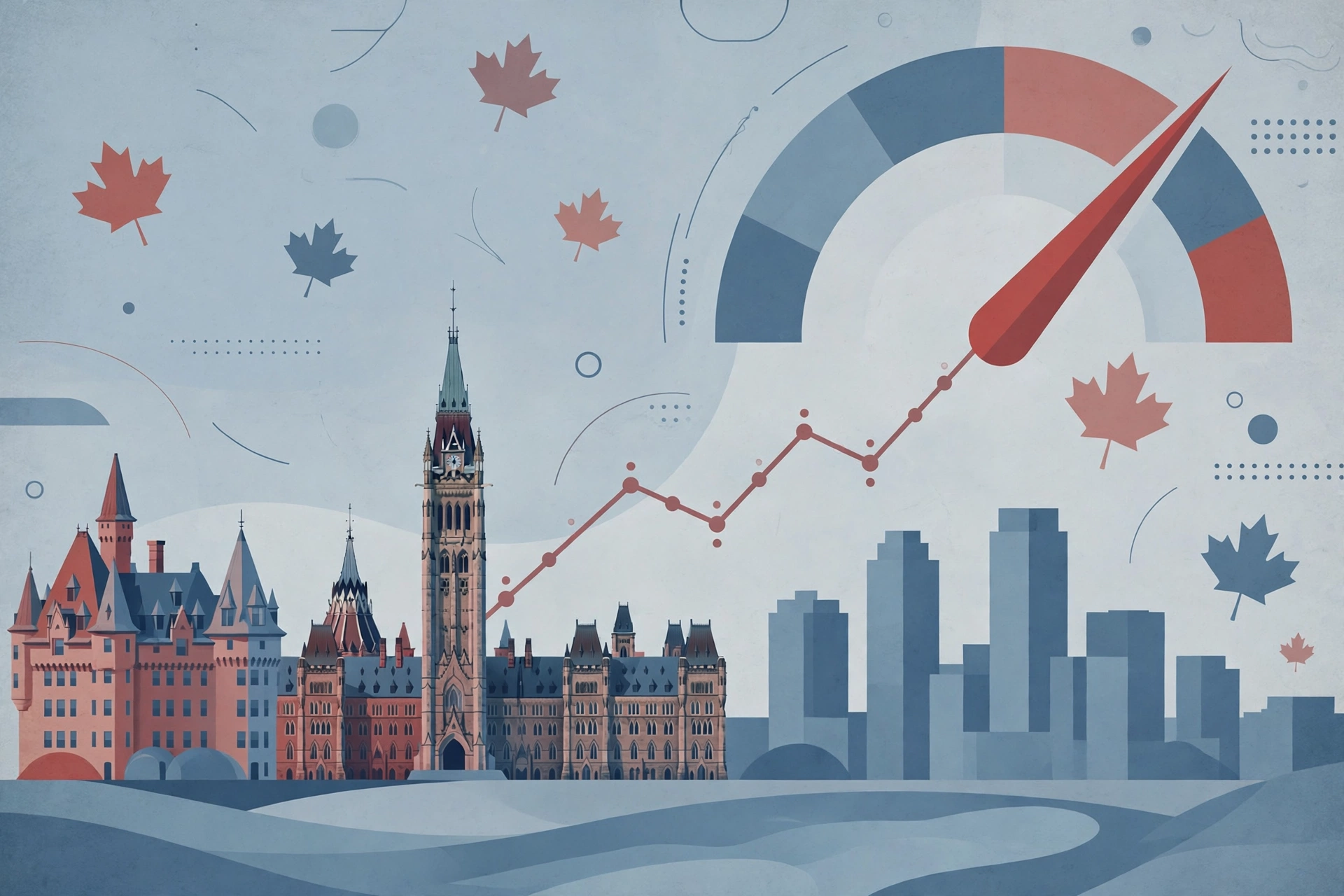
The Bank of Canada announces its policy-rate decision at 9:45 a.m. ET on Wednesday, Oct. 28, alongside its quarterly Monetary Policy Report, with Governor Tiff Macklem holding a press conference afterwards. The policy rate has stood at 2.25% since a cut in October 2025, with seven straight holds since — and the Bank has not raised rates since July 2023.
This is the first decision in a year where the outcome is genuinely in doubt, and the stakes run straight to household budgets: a 25-basis-point move typically flows through to variable mortgage rates and the prime rate, currently 4.45%, within a billing cycle.
The flip — from hold to hike in ten days
The market's base case flipped fast. In the Reuters poll conducted Oct. 21–23, 19 of 34 economists (56%) expected a 25-basis-point hike to 2.50% on Oct. 28, with another rise by end-March — a reversal from the previous Reuters poll, in which 80% expected the Bank to stay on hold through the end of 2026.
Market pricing tells the same story, dated: CORRA-based overnight-index-swap pricing put the odds of a hike at about 78% as of Oct. 23, according to BlueGamma, and Bloomberg data reported by Canadian Mortgage Professional put it near 75% on Oct. 26. The Globe and Mail reported overnight swaps implying a 75% chance, while other Bloomberg reads put it as high as 87% — the range itself is a reminder that these are market bets, not the Bank's decision.
What flipped it, according to Reuters reporting, was September inflation plus Governor Macklem's warning in Bangkok on Oct. 17 that the Bank expects to raise its inflation forecast significantly, asking whether inflation would come back to target on its own or whether the Bank would have to raise rates to influence the path.
The case for a hike
Headline inflation rose to 3.1% in September, according to Statistics Canada, above the Bank's 1–3% target range, though below the 3.2% Reuters consensus. Energy drove it: gasoline was up 27.8% year over year and fuel oil 57.8%, with energy overall up 19.0%.
The Bank's own third-quarter surveys, released Oct. 19, added to the worry: consumer expectations for inflation five years out hit 3.91%, the highest since 2022, and firms said they planned to pass tariff costs through to customers. Desjardins, RBC Economics and CIBC now expect a hike, with Desjardins' Royce Mendes telling Reuters the survey responses suggested more serious inflationary pressures were coming.
The case for a hold
The hold case is not a fringe view — it is the other half of a genuinely two-sided decision. Core inflation cooled: CPI-trim was 1.8% and CPI-median 1.9% in September, both down from August, and inflation excluding gasoline was 2.2%, down from 2.4%.
The labour market is soft: the economy lost 68,300 jobs in September and unemployment sits at 6.5%, according to Statistics Canada. TD and BMO still expect a hold, and Rabobank strategists Christian Lawrence and Molly Schwartz expect a hold at 2.25% through the next 12 months despite markets pricing an 85% chance of a hike, citing mixed labour data and inflation concentrated in shelter and energy, according to FXStreet's Oct. 26 report of their view. Rabobank's own risk skew is toward a hike at this meeting — a hold call with the risk flagged, not a dovish pivot.
What it means for borrowers
As an illustration only, not financial advice: a 25-basis-point rise adds roughly $41 a month on a $300,000 mortgage, $68 on $500,000 and $103 on $750,000, on a prime-minus-0.40% variable rate over 25 years. Fixed rates have already priced in much of the expected tightening path, so the bigger swing for fixed borrowers comes from how the statement and forecasts shift December expectations.
What to watch at 9:45
Watch three things: the decision itself; the new Monetary Policy Report forecasts, which Macklem has already flagged will be raised significantly; and his press-conference language on whether a hike today, if it comes, is the start of a path or a one-off insurance move. The U.S. Federal Reserve decides at 2 p.m. ET the same day, and August GDP lands Friday, Oct. 30, with the Bank's final decision of 2026 on Dec. 9.
What matters
What happened
The Bank of Canada decides at 9:45 a.m. ET on Oct. 28, with new forecasts and a Macklem press conference to follow.
Why it matters
It is the first genuinely uncertain decision in a year, and it sets borrowing costs for variable-rate holders and the tone for December.
What we know
Markets price roughly a three-in-four chance of a hike to 2.50%, but core inflation cooled and jobs fell — the hold case is live.
What we don’t
The decision itself, the new forecasts, and whether Macklem frames any move as the start of a tightening path.
What’s next
Our decision story lands after 9:45 a.m.; then the Fed at 2 p.m. ET, August GDP on Oct. 30, and the Bank's final 2026 decision on Dec. 9.
Sources
Interest ratesInflationBank of CanadaTiff Macklemmortgages
Newsletter
News. Context. What matters.
One essential briefing, written for people who would rather understand the story than scroll it.
Unsubscribe anytime. We don’t sell addresses.
Recommended

Money
Amex posted a record quarter — then announced it's cutting 3,500 jobs to get ready for AI
American Express reported record third-quarter revenue of $20.1 billion and raised its profit outlook, then told analysts it will cut about 5 per cent of its workforce in a $336-million restructuring its CFO says is meant "to prepare for AI."
Money
The Bank of Canada is now expected to hike rates on Oct. 28 — and hike again by spring
A Reuters poll of 34 economists finds 56% now expect a quarter-point hike to 2.50% next Wednesday, with another rise by end-March, after September's 3.1% inflation reading and sharply rising expectations.
Money
Canadians spent big in August. That just made the Bank of Canada's October call a coin flip.
Retail sales rose 1.2% to $74.57 billion in August, the last major data point before next week's rate decision — and economists are split on whether the Bank hikes or holds.