Money
Why is the Canadian dollar sinking?
The petrodollar playbook says this can't happen. The rate gap, the trade war and a decade of neglected productivity say otherwise.
Published: October 13, 2026 · Updated: October 13, 2026 · 4 min read
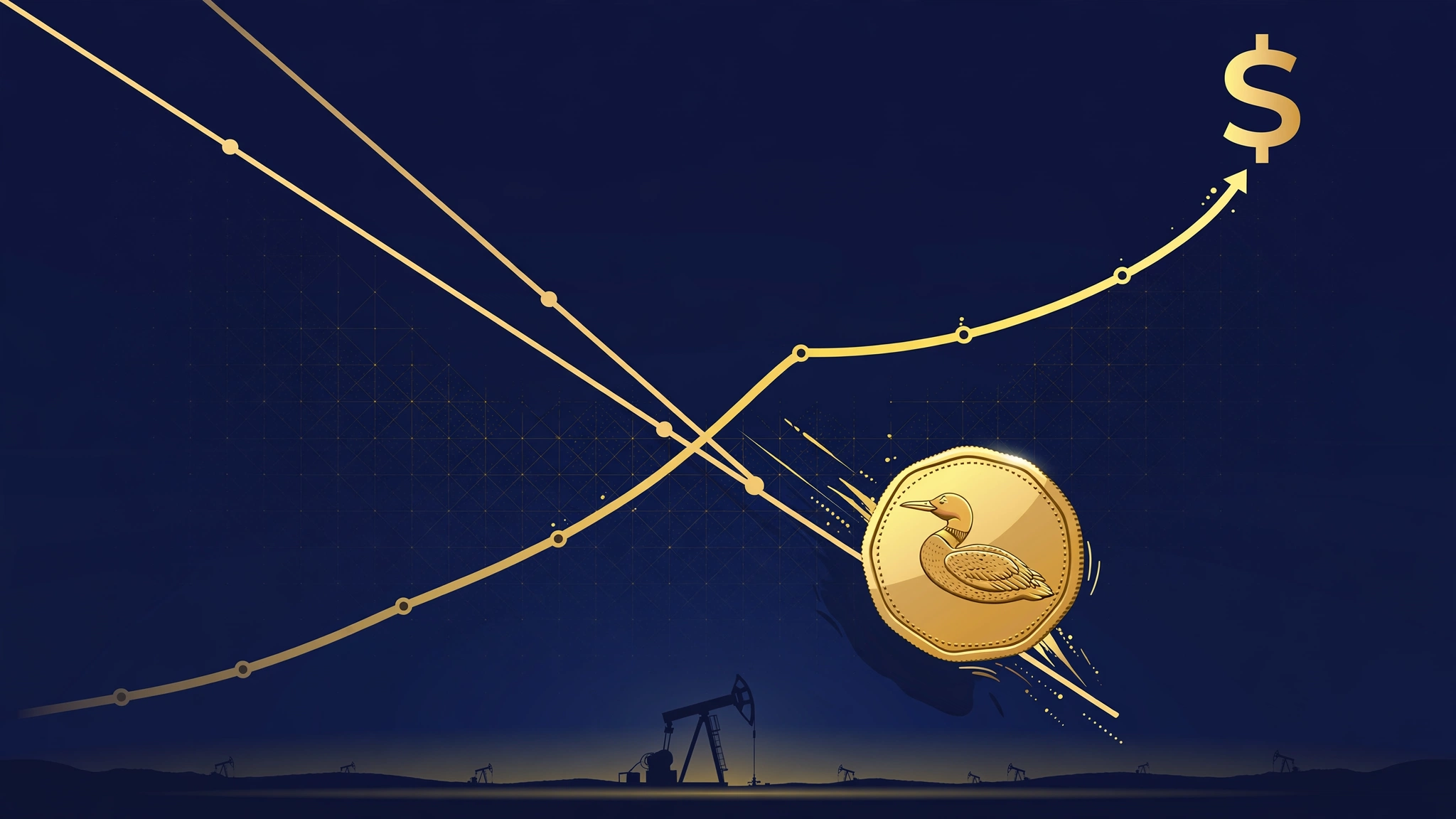
The Canadian dollar just hit an 18-month low — USD/CAD touched 1.4298 on Oct. 9, putting the loonie at roughly 70 U.S. cents, its weakest since April 2025. And it happened while Brent crude settled at $106.65 a barrel on Oct. 12, the highest since mid-September. The textbook says oil up means loonie up. The textbook needs an update.
Start with the most mechanical reason: money follows yield, and right now yield is in America. The U.S. Federal Reserve hiked unanimously to 3.75–4.00 per cent in September while the Bank of Canada has sat frozen at 2.25 per cent for a year — a 150 to 175 basis-point gap. The U.S. 10-year Treasury closed Oct. 9 at 5.24 per cent, its highest since 2002, against Canada's 10-year at about 3.93 per cent. That roughly 130-basis-point spread is a standing payment to global investors for holding dollars instead of loonies. As FXStreet put it in June, when one central bank is leaning toward hikes and the other is frozen, "the rate spread does the talking." Speculative short positions on the currency have climbed to multi-month highs.
Here's the twist that makes this a genuinely strange episode: foreigners are buying Canadian bonds at a record pace — C$104 billion of federal government bonds in the first seven months of 2026, up from C$13.8 billion in all of 2025, lifting the foreign share of outstanding federal bonds from 40.2 to 46.5 per cent, according to Statistics Canada. The bond market loves Canada's credit. The currency market is voting on something else entirely: the rate gap. Credit and currency have decoupled.
So has oil. In June, FXStreet reported that the rolling correlation between daily moves in the loonie and crude oil "has turned negative in recent months, a clean break from the historical norm" — the currency, it wrote, "has quietly stopped trading like a crude oil proxy." Gold has taken oil's place as the anchor, and gold has fallen roughly 25 per cent from its January record of $5,589 an ounce to about $4,180. Scotiabank's economists explained the mechanics in April: supply-driven oil rallies like the current one — driven by war, not demand — are "less CAD-supportive" than demand-driven ones, because they arrive alongside weak global demand and flight-to-safety flows into the U.S. dollar. Oil can surge and the loonie can still sink, because the world is buying crude for fear and dollars for safety.
Then there's the trade war, which is doing slow structural damage beneath the daily noise. The U.S. Section 338 tariffs — the first-ever use of the 1930 provision — slapped 50 per cent levies on 554 tariff lines covering roughly $20–27.6 billion of Canadian goods starting Aug. 22, on top of 50 per cent sectoral tariffs on steel, aluminum, autos and lumber. A Canadian Federation of Independent Business survey of 1,545 owners found 26 per cent reporting major negative impacts, with a median monthly tariff cost of $65,000 — and 18 per cent of affected exporters saying they would stop being financially viable if the trade war lasts three more months. Governor Macklem warned in September that if tariffs persist, fourth-quarter growth could roughly halve to below 1 per cent. Deloitte just cut its 2027 growth forecast to 1.6 per cent. A currency is, in the end, a claim on future growth — and the market is repricing Canada's.
That repricing has been a decade in the making. The Fraser Institute reported in May that Canadian capital spending on productivity-enhancing assets — machinery, equipment, software — remains below 2014 levels, at 11.1 per cent of GDP last year versus nearly 14 per cent in 2014, even as the labour force expanded 51 per cent. The average Canadian worker, in other words, has worse tools than a decade ago. The Information and Communications Technology Council put it bluntly in March: labour productivity grew just 0.9 per cent over ten years, leaving Canada second-to-last in the G7 — an "emergency level" problem. In 2024, the Bank of Canada's own senior deputy governor called it a national emergency. Add population growth of 0.5 per cent — the slowest since 1915–16, which Prime Minister Carney himself acknowledged is contributing to economic weakness — and the growth story the loonie is supposed to reflect keeps shrinking.
What do the forecasters see? The Big Six banks' house views average about 1.40 for the fourth quarter of 2026, drifting to roughly 1.36 by late 2027 — weakness persisting, then slowly fading. Scotiabank's foreign-exchange outlook sees 1.37 by year-end and 1.33 by end of 2027. The Bank of Canada's own market-participants survey puts the median at 1.37 for end-2026. Nobody is calling for a collapse; the consensus is a long, grinding softness that only reverses if the rate gap narrows.
My read: the loonie's decline is overdetermined, which is what makes it durable. A rate gap that pays the world to short Canada, a petrocurrency link broken by the nature of the oil shock, a trade war taxing the export engine, and a decade of underinvestment in the things that make an economy grow. Carney's government is reaching for the right lever — September's expanded capital expensing, covering roughly two-thirds of all business investment, is meant to give Canada the lowest marginal effective tax rate in the G7, "less than half the U.S. rate." Economist Trevor Tombe called it an answer to "the single largest economic challenge Canada faces." But tax incentives take years to move the capital stock, and currencies move in days.
For Canadians, the bill arrives quietly: pricier imports, more expensive Florida winters and cross-border shopping, and imported inflation that makes the Bank of Canada's job harder. The loonie is a daily referendum on the Canadian growth story. Right now the verdict is brutal but specific — great credit, no growth premium. Until that changes, 70 cents isn't an anomaly. It's the price.
What matters
What happened
USD/CAD hit 1.4298 on Oct. 9 — an 18-month high, the loonie at ~70 U.S. cents — while Brent crude traded near $105, breaking the petrocurrency pattern.
Why it matters
A weak loonie means pricier imports, costlier travel and imported inflation — and it signals markets repricing Canada's growth story.
What we know
The Fed–BoC rate gap is 150–175bp with a ~130bp 10-year yield spread; the CAD–oil correlation has turned negative; bank forecasts average ~1.40 for Q4 2026 drifting to ~1.36 by late 2027.
What we don’t
Whether the Fed–BoC rate gap narrows after the Oct. 28 decisions, whether the loonie–oil link reasserts itself on a demand-driven rally, and how fast Carney's investment tax measures turn into real capital spending.
What’s next
Watch the Oct. 28 BoC decision, the Fed the same day, any tariff de-escalation, and whether Carney's investment tax measures start moving the capital stock.
Sources
Interest ratesBank of Canadaoil pricesopinionCanadian dollarUSD/CADloonieFederal Reserve
Newsletter
News. Context. What matters.
One essential briefing, written for people who would rather understand the story than scroll it.
Unsubscribe anytime. We don’t sell addresses.
Recommended
Money
The Bank of Canada decides in four hours. The market says hike — the economy says wait.
At 9:45 a.m. ET the Bank sets its policy rate and publishes new forecasts. Markets lean heavily toward a hike to 2.50%, but the case for holding at 2.25% is real — and a surprise either way moves mortgages, the loonie and December bets.

Money
Amex posted a record quarter — then announced it's cutting 3,500 jobs to get ready for AI
American Express reported record third-quarter revenue of $20.1 billion and raised its profit outlook, then told analysts it will cut about 5 per cent of its workforce in a $336-million restructuring its CFO says is meant "to prepare for AI."
Money
The Bank of Canada is now expected to hike rates on Oct. 28 — and hike again by spring
A Reuters poll of 34 economists finds 56% now expect a quarter-point hike to 2.50% next Wednesday, with another rise by end-March, after September's 3.1% inflation reading and sharply rising expectations.