Money
Brent crude fell back from $110 as Trump's Russia waiver promised more fuel — while gold pushed toward $4,200
Monday's split-screen markets capture an energy shock colliding with a political one: Brent slid nearly 2 per cent off its five-month high as markets weighed more Russian fuel supply, while gold climbed toward record territory. Here's what it means for Canadian gas prices — and the Bank of Canada's Oct. 28 rate call.
Published: October 19, 2026 · Updated: October 19, 2026 · 2 min read
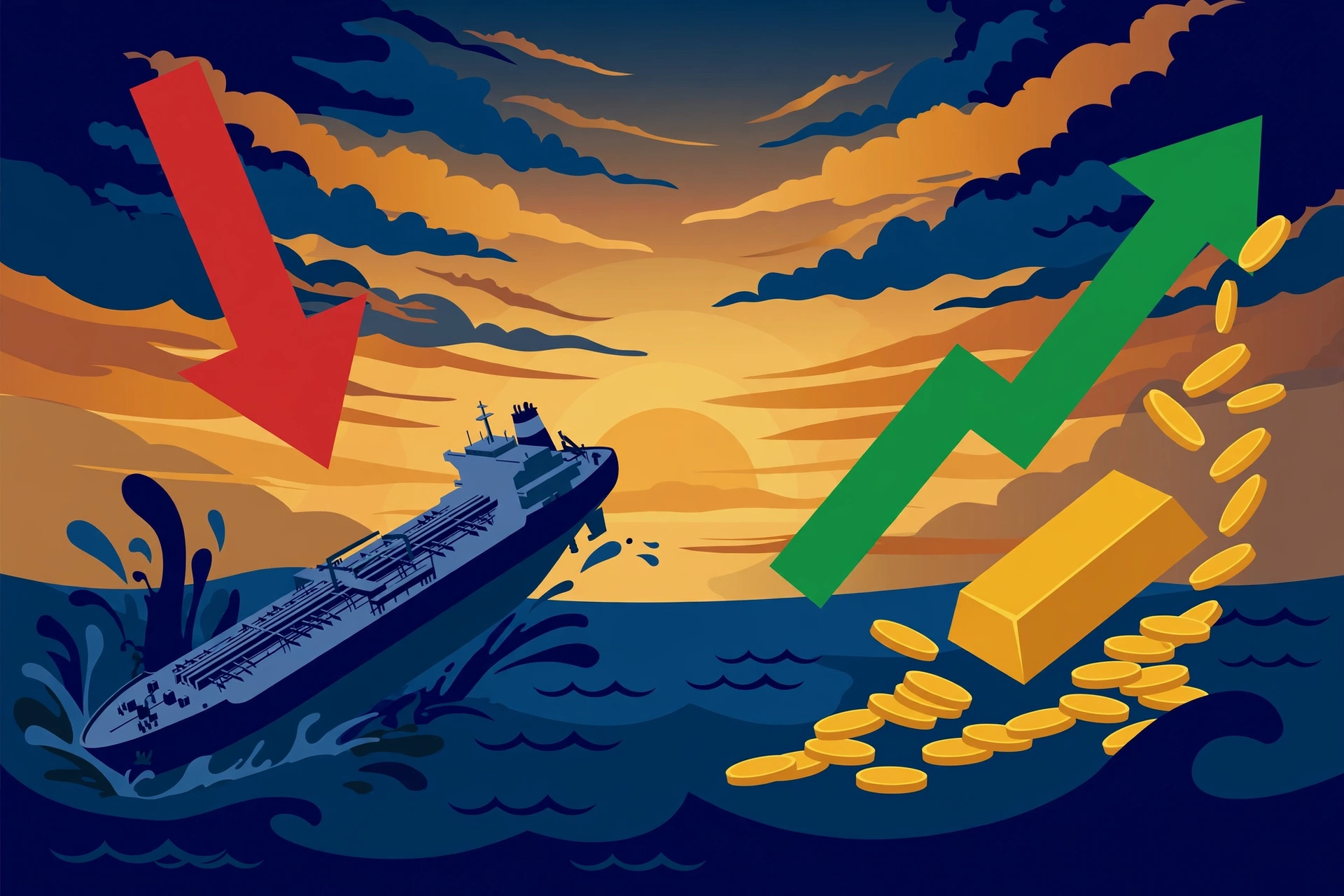
Brent crude fell sharply in Monday's early trading, giving up the five-month high it touched on Friday. Futures were down $1.94, or 1.77 per cent, to $107.92 a barrel by 0227 GMT, according to Reuters' market reporting. U.S. benchmark West Texas Intermediate fell 83 cents to $100.58 — still its strongest level since mid-September.
The trigger was political. On Friday night, U.S. President Donald Trump signed an executive order waiving key sanctions and tariffs on Russia under the Graham Act — just two days before the measures were due to take effect. The order followed Trump's announcement of a deal to buy Russian diesel, starting at about 2.3 million barrels this month and rising to roughly 7.6 million barrels monthly, for distribution in the U.S. and other markets. Secretary of State Marco Rubio said the administration would use up to 60 days to assess the economic impact of the sanctions relief.
Markets are pricing in the prospect of more fuel reaching global markets. But the supply relief is conditional. "The combination of a softer tone around sanctions and some profit-taking after recent gains is helping to cap the upside in the near term," KCM Trade chief analyst Tim Waterer said — adding that "until the details and duration are clearer, the market is unlikely to fully price in a sustained increase in supply."
The pullback does not mean the energy shock is over. Brent touched $110 on Friday for the first time since May after a week of attacks on commercial vessels in the Middle East. Analytics firm Kpler reported at least 10 confirmed vessel incidents last week, with Gulf crude flows collapsing to about 8.5 million barrels a day on a seven-day average — down from more than 20 million the week before. Egypt said it stands ready to support Saudi Arabia against Yemen's Houthis, raising the prospect of a wider confrontation around the shipping lanes.
DBS Bank's head of energy research, Suvro Sarkar, told Reuters he expects prices to stay rangebound between $100 and $110 a barrel going into the U.S. midterms — calling Trump's moves "short-term fixes" that "will have barely any structural impact on the supply situation."
While oil retreated, gold kept climbing. Spot gold gained 0.3 per cent to $4,175.60 an ounce by 0259 GMT, with December U.S. futures up 0.4 per cent to $4,196.40 — edging toward $4,200, according to Invezz's market reporting. The logic runs through interest rates: cheaper fuel could cool inflation expectations and take pressure off further U.S. rate hikes, lowering the opportunity cost of holding gold — a benefit that may outweigh any dip in safe-haven demand. Gold ETFs drew $10 billion in September even as futures investors cut exposure.
For Canadians, the split-screen matters at the pump and at the central bank. Pump prices tend to follow crude with a lag, so Monday's pullback offers only partial relief after Friday's spike. And the Bank of Canada heads into its Oct. 28 decision in the bind governor Tiff Macklem described over the weekend: the bank has been "looking through" higher energy prices, "but the longer this goes, the harder that gets." September CPI lands at 8:30 a.m. ET this morning — the next data point that will decide whether that bind tightens.
What matters
What happened
Brent crude fell about 1.8 per cent to $107.92 a barrel in Monday's early trading after touching $110 on Friday; WTI sat at $100.58. Gold climbed toward $4,200 an ounce at the same time.
Why it matters
The pullback came from Trump's Friday order waiving Russia sanctions and a new Russian diesel deal — but tanker attacks in the Middle East keep the supply risk alive, and gold's climb shows investors are still buying insurance.
What we know
Diesel shipments to the U.S. start at about 2.3 million barrels this month, rising to roughly 7.6 million monthly; Rubio says the U.S. has up to 60 days to assess the sanctions relief; Gulf crude flows fell to 8.5 million bpd from more than 20 million; at least 10 vessel incidents were confirmed last week.
What we don’t
Whether the waiver sticks for the full 60 days or becomes permanent; how quickly pump prices respond; whether gold breaks $4,200 this week.
What’s next
Canada's September CPI drops at 8:30 a.m. ET today; the Bank of Canada decides Oct. 28; DBS expects oil to stay between $100 and $110 into the U.S. midterms.
Sources
- Oil Monster — "Oil tumbles as Trump's Russia sanctions waiver may lead to more fuel supplies" · other
- Euronext (Reuters reporting) — "Oil slips from 5-month high as Trump's Russia sanctions waiver may bring more supplies" · other
- Invezz — "Trump's Russia surprise sends oil lower, so why is gold nearing $4,200?" · other
InflationBank of Canadaoil pricesmarketsgas pricesgold
Newsletter
News. Context. What matters.
One essential briefing, written for people who would rather understand the story than scroll it.
Unsubscribe anytime. We don’t sell addresses.
Recommended

Money
OPEC+ agrees to hold December oil output steady — leaving the war, not quotas, to set the price
Seven core producers agreed in principle at a Sunday online meeting to leave December targets unchanged, Reuters reported, pausing output policy until 2027 quota talks — with Brent's December contract closing Friday at $117.64.
Money
The Fed held rates — hours after the Bank of Canada hiked. Here's what the split means for Canadians.
The U.S. Federal Reserve kept its benchmark rate at 3.75% to 4% on Wednesday in a 10–2 vote, pausing after September's hike even as inflation stays elevated. For Canadians, the divergence with Ottawa's morning hike is the story: no relief for borrowers from south of the border, and a firmer case for the loonie.
Money
Bank of Canada hikes for the first time since 2023 — and warns more could follow.
At 9:45 a.m. ET on Wednesday the Bank raised its policy rate to 2.50%, its first increase since July 2023, saying high energy prices risk spreading into broader inflation. It also signalled caution: further hikes are possible, but decisions will come one meeting at a time.