Business
Wall Street just had its worst day since the tariff shock — AI stocks led the rout
The S&P 500 fell 4.4 per cent on Thursday, its worst day since April 2025, as investors dumped the chip and data-centre stocks that carried the AI boom. The Nasdaq is now in a correction — though it bounced back on Friday.
Published: November 6, 2026 · Updated: November 6, 2026 · 2 min read
A brutal sell-off swept through Wall Street on Thursday, led by the stocks tied to the buildout of artificial-intelligence data centres, in the market's worst day since the tariff shock of April 2025.
The S&P 500 fell 4.4 per cent, or 334.89 points, to 7,353.73, the Associated Press reported. The Dow Jones Industrial Average sank 1,833 points, or 3.4 per cent, to 51,523.06, more than erasing its 1,569-point gain from the day before. The Nasdaq composite tumbled 5.5 per cent to 24,315.00 — its worst day in 18 months — and now sits nearly 12 per cent below its record high from last month, putting it in correction territory.
Chips led the fall
The damage was heaviest in semiconductors. Nvidia, the chip company that became the face of the AI boom, fell 9.3 per cent and was by far the heaviest weight on the S&P 500, the AP reported. Advanced Micro Devices tumbled 17.3 per cent, Broadcom fell 10.4 per cent, and the Philadelphia Semiconductor Index plunged 12.25 per cent — its biggest one-day decline since April 2025, according to Reuters figures cited by Gulf Business.
Companies that rent access to AI chips also plunged: CoreWeave fell 9.8 per cent, and GE Vernova, which helps power data centres, sank 7.5 per cent. About $3 trillion was erased from the market capitalisation of S&P 500 companies in a single session, Reuters reported.
Why investors sold
The selling followed the Democrats' sweep of both chambers of Congress in Tuesday's midterm elections, and reflects two worries that have been building for weeks, according to the AP and Reuters: stretched valuations after a year-long AI rally, and doubts about the returns on the hundreds of billions of dollars pouring into data centres — including fears of tougher scrutiny of data-centre construction and of how easily the companies building them can keep borrowing to fund it.
The VIX, Wall Street's "fear gauge," spiked to 28.09 intraday, its highest since late March, when the Iran conflict escalated, Seoul Economic Daily reported.
Friday: a partial rebound
The bleeding paused on Friday. By midday, the Nasdaq was up about 1.6 per cent at roughly 24,695 and the S&P 500 up about 0.8 per cent at roughly 7,415, while the Dow was little changed at about 51,530 after falling roughly 450 points at the open, according to market reports. Nvidia climbed about 4 per cent as chip stocks recovered, and the 10-year Treasury yield held at about 4.85 per cent.
Even with the bounce, the week has left marks: compared with Tuesday's close, the Nasdaq was still down about 2.6 per cent and the S&P 500 about 2.1 per cent at midday Friday.
What it means in Canada
Canadian investors felt the rout through their pensions and RRSPs, which hold many of the same U.S. tech names, and through the TSX, which had already slid to its lowest since early October earlier in the week as Shopify and Thomson Reuters fell. The data-centre scrutiny behind part of the selling also lands close to home: Meta is spending more than C$13 billion on a one-gigawatt AI data centre in Alberta, the company's first in Canada, and the economics of that buildout are now under the same investor microscope.
Asian markets opened lower on Friday, with Japan's Nikkei 225, South Korea's KOSPI and Hong Kong's Hang Seng each falling more than 1 per cent, Al Jazeera reported.
What matters
What happened
The S&P 500 fell 4.4% on Thursday, its worst day since April 2025; the Nasdaq fell 5.5% into correction territory and the Dow lost 1,833 points. About $3 trillion in S&P 500 market value vanished in a day.
Why it matters
The sell-off hit the AI and chip stocks that have driven the market's gains — Nvidia fell 9.3%, AMD 17.3%, and the chip index plunged 12.25%. Canadian pensions, RRSPs and the TSX all hold exposure to the same names.
What we know
Investors are questioning AI valuations and the returns on data-centre spending after the Democrats' midterm sweep, with fears of tougher scrutiny of data-centre construction. The Nasdaq bounced about 1.6% by midday Friday after a strong U.S. jobs report.
What we don’t
What’s next
Watch whether buyers step back in, whether the data-centre financing worries spread — including to projects like Meta's Alberta buildout — and what Tuesday's U.S. inflation report says about the Fed's next move.
Sources
- Associated Press (via Louisiana First News) — A brutal sell-off for AI stocks sends Wall Street reeling, and the S&P 500 drops 4.4% · other
- Gulf Business — Global AI stock selloff wipes trillions off Wall Street as Nasdaq plunges 5.5% · other
- Seoul Economic Daily — U.S. Stocks Plunge as AI Panic Selling Hits Chip Index 12% · other
- Al Jazeera — Oil prices jump as US, Iran trade fire in Strait of Hormuz · other
- Invezz — Nasdaq rebounds 1% as chip stocks recover; Dow falls despite strong jobs data · other
- BeInsure — US Stock Market: Nasdaq rebounds as Dow falls after $3 tn AI selloff · other
- JBizNews — Stocks Catch Their Breath After Two Wild Days · other
- TradingView (dpa-AFX) — U.S. Stocks Regaining Ground Following Yesterday's Sell-Off · other
NvidiaAI stocksNasdaqstock marketsS&P 500Wall Street
Newsletter
News. Context. What matters.
One essential briefing, written for people who would rather understand the story than scroll it.
Unsubscribe anytime. We don’t sell addresses.
Recommended
Business
U.S. added 165,000 jobs in October — and now a December rate hike looks likely
Payrolls blew past forecasts of 65,000 and unemployment fell to 4.1 per cent. Traders now price a roughly 80 per cent chance the Fed hikes in December — a move that would ripple through Canadian mortgage rates and the loonie.
Business
Shopify slides and the TSX sinks to its lowest since early October as trade-deal hopes stay vague
Shopify fell after third-quarter revenue slightly missed estimates, Thomson Reuters dropped on AI-spending worries, and the TSX closed at its lowest level since October 8 — all while investors waited for real details on a U.S.-Canada trade deal.
Business
Pre-election panic buying? The data show a spike in searches, not a shopping spree
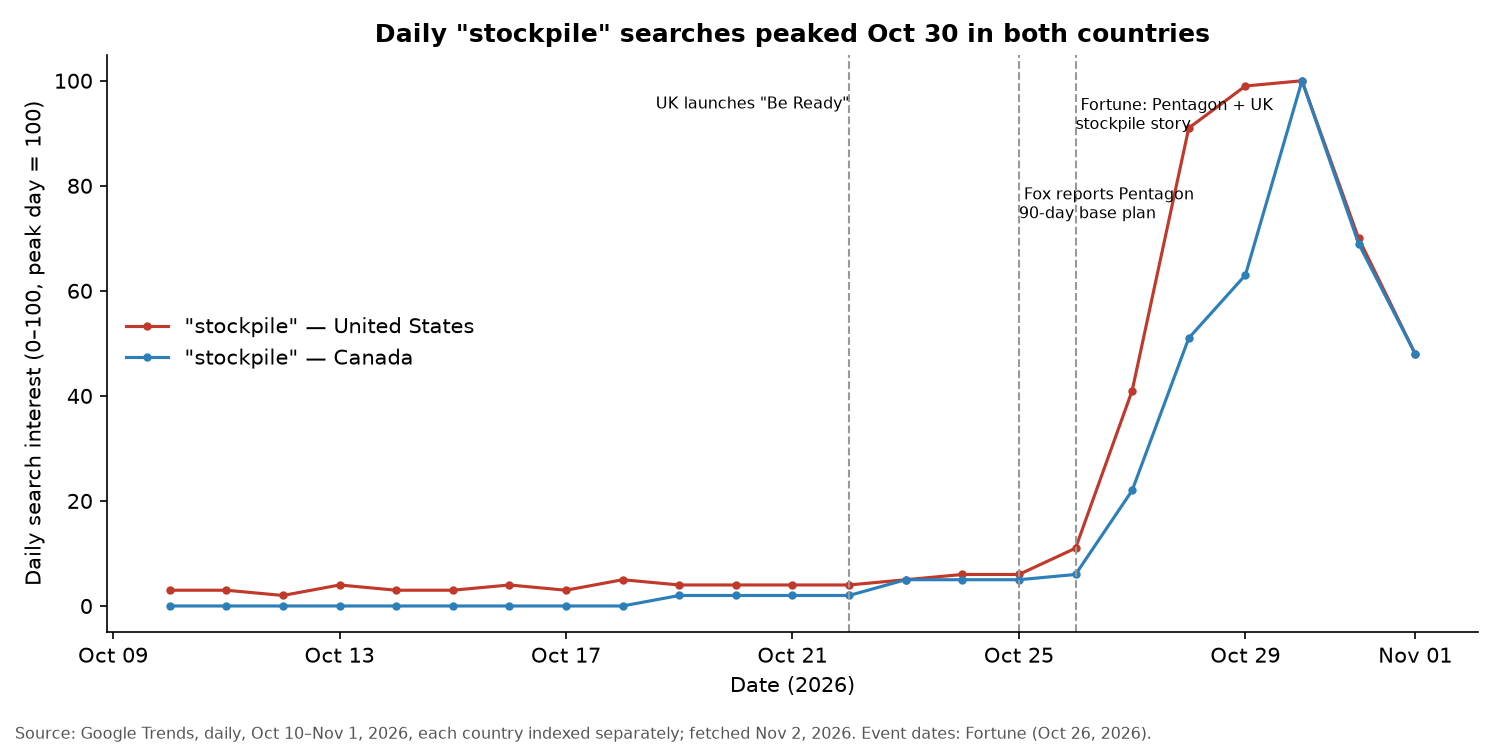
Searches for "stockpile" jumped in late October in both Canada and the U.S. Spending data show households cutting back on groceries and paying more for gas, not hoarding ahead of Nov. 3.