Business
Pre-election panic buying? The data show a spike in searches, not a shopping spree
Searches for "stockpile" jumped in late October in both Canada and the U.S. Spending data show households cutting back on groceries and paying more for gas, not hoarding ahead of Nov. 3.
Published: November 3, 2026 · Updated: November 3, 2026 · 6 min read
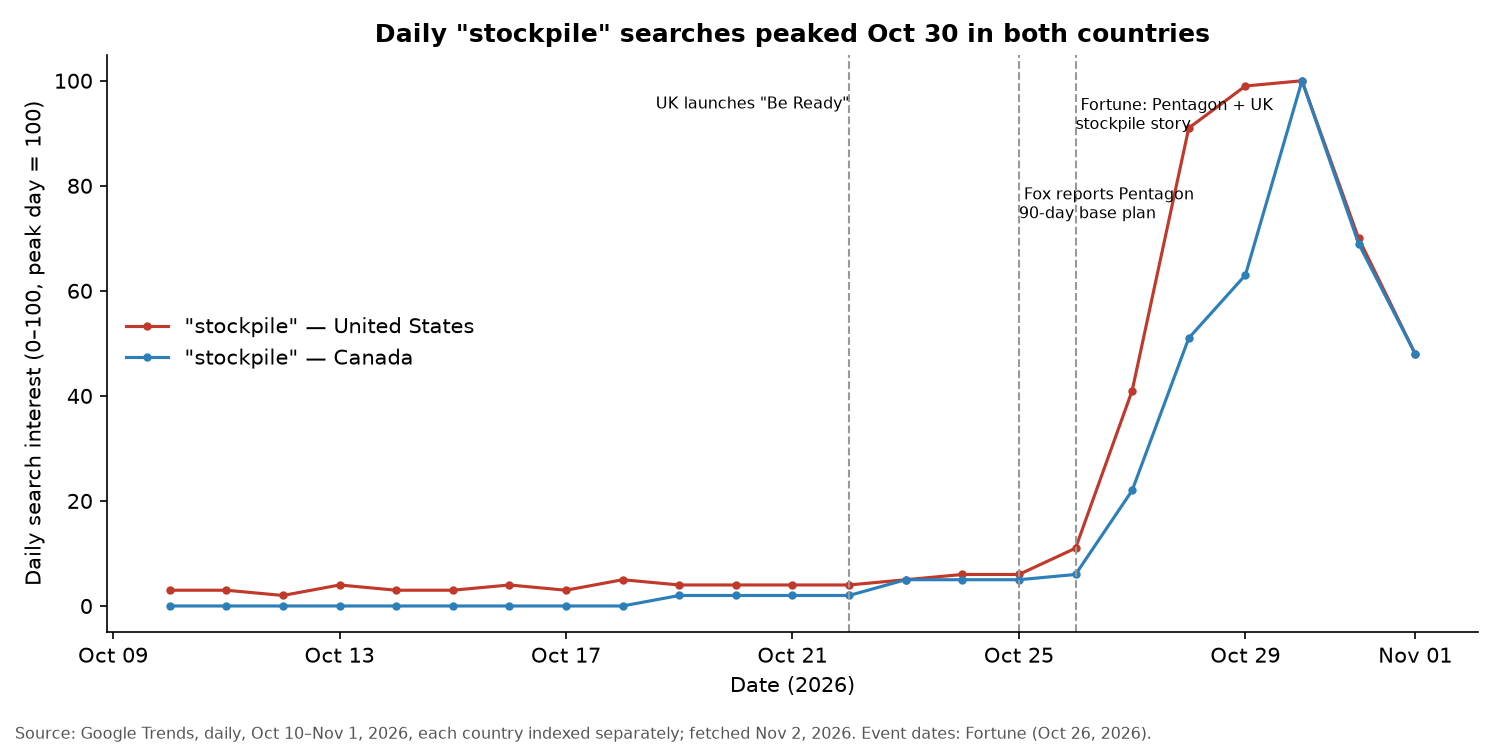
There is no hard evidence that Americans or Canadians are stocking up on supplies ahead of the Nov. 3 U.S. midterm elections because of war fears. What the data do show is a sudden burst of online curiosity. Google searches for "stockpile" rose roughly 13-fold in the U.S. in the last week of October, peaking on Oct. 30. The trigger appears to have been government preparedness messaging, not the election, and it has not yet shown up at the till.
The four charts with this story track Google search interest in both countries, retail sales by category, and U.S. gas prices against consumer sentiment.
Key numbers
- About 13x: rise in U.S. weekly Google search interest for "stockpile," from 3 to 40, between the week of Oct. 18 and the week of Oct. 25 (Google Trends, fetched Nov. 2)
- +0.9%: U.S. grocery-store sales, September, year over year, below food-at-home inflation of 1.8% (Census Bureau via FRED; BLS via FRED)
- +0.5%: Canadian grocery and convenience sales, August, year over year, below the 2.8% rise in grocery prices that month (Statistics Canada; StatCan CPI)
- +28.1%: U.S. gas-station sales, September, year over year, driven by price (Census Bureau via FRED)
- 70%: share of U.S. consumers who expect to cut back on (54%) or stop buying (16%) items with big price increases (University of Michigan, Oct. 9)
- −6.87%: change in December gold futures in October; they settled at US$3,898.90 an ounce on Oct. 30 (Argaam)
What happened to searches in late October?
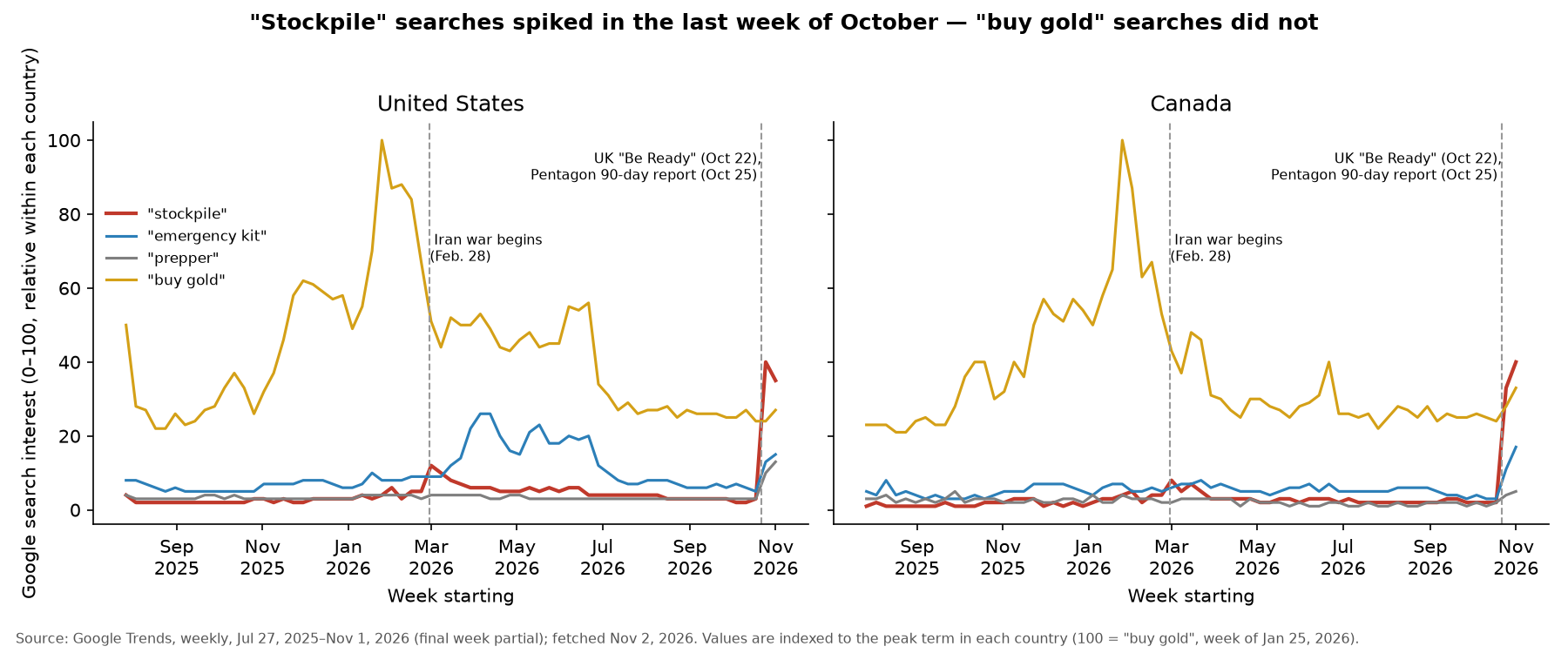
Weekly Google Trends data for both countries were flat through most of the fall. In the week of Oct. 25, U.S. interest in "stockpile" climbed to 40 from 3 the week before, and Canadian interest rose to 33 from 2. On a daily basis, both countries peaked on Oct. 30. "Emergency kit" searches rose to 13 from 5 in the U.S. and to 11 from 3 in Canada, and "prepper" rose to 10 from 3 in the U.S.
Related searches include queries about government stockpiling advice.
The timing lines up with a cluster of preparedness news. Britain launched its "Be Ready" household campaign on Oct. 22, advising families to keep water, non-perishable food and cash for three days of disruption. On Oct. 25, Fox News Digital reported, citing documents it reviewed, that under a Pentagon initiative called FORTRESS every major military installation in the continental U.S. "would be expected to sustain essential operations independently for at least 90 days," including electricity, water, fuel and communications. Fortune tied the two together on Oct. 26, noting the plan covers military bases, not households, and that neither government has said a new war is imminent. French prefectures also renewed calls for 72-hour emergency kits in late October (RTL).
The News Desk found no new federal stockpiling advisory in Canada in October. Ottawa's standing advice is to keep a 72-hour emergency kit.
Google Trends measures relative interest, scaled from 0 to 100, not sales or the number of people searching. A spike from a very low base can look dramatic.
Is that curiosity showing up in shopping carts?
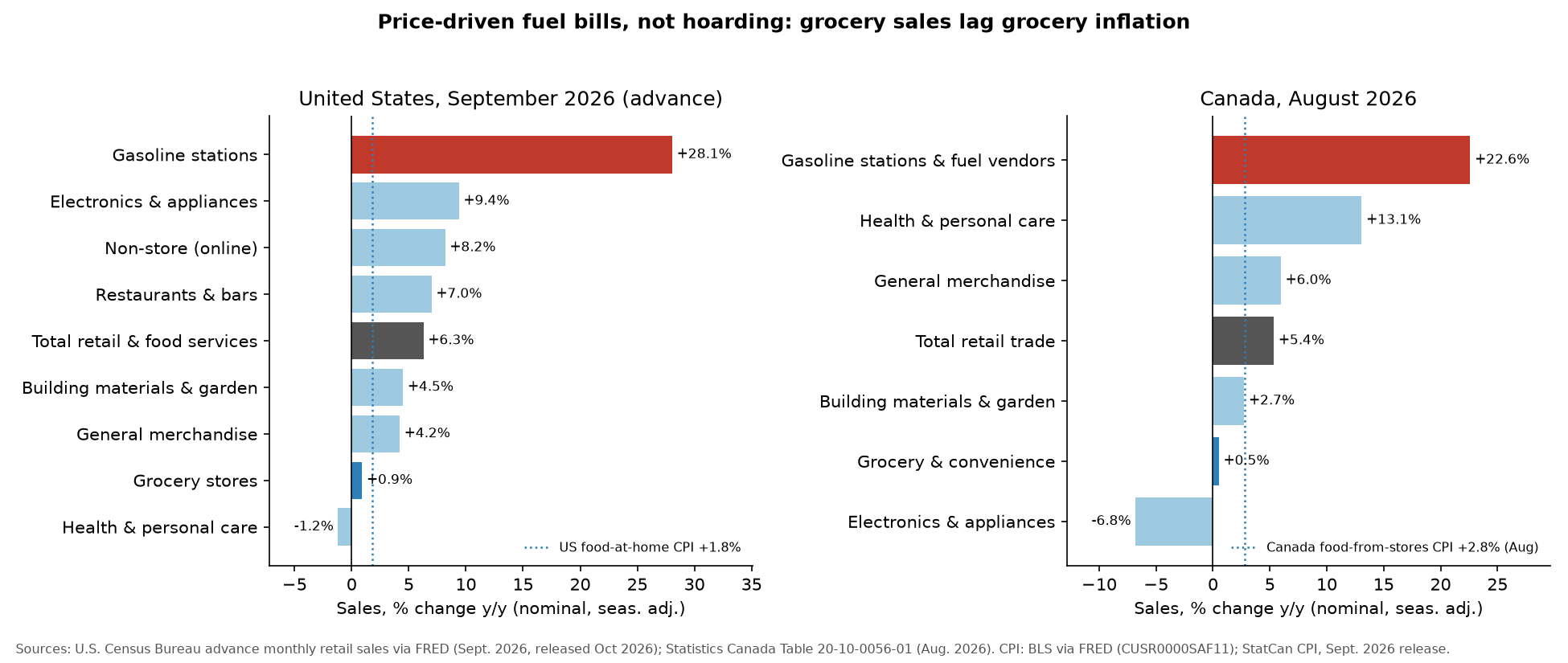
Not in the latest official data, which run only to September in the U.S. and August in Canada, though Statistics Canada's advance estimate points to a 0.7% rise in total Canadian retail sales in September. U.S. grocery-store sales rose 0.9% from a year earlier in September, while food-at-home prices rose 1.8%. That suggests shoppers bought slightly less food in volume terms, not more. Health and personal care store sales fell 1.2%. Total retail and food-service sales rose 6.3%, but gas stations alone were up 28.1%, almost entirely because of price.
Bank of America's October Consumer Checkpoint found September card spending per household up 6.2% year over year, or 5.1% excluding gasoline, and called spending "very solid." It said month-over-month spending was "more muted, especially without gas." Solid spending is not the same as stockpiling, and the bank did not report a surge in essentials.
In Canada, grocery and convenience sales were up 0.5% year over year in August and down 1.2% from February, the month the Iran war began (Feb. 28). Grocery prices rose 2.8% in August. Gas-station sales rose 1.7% in August from July but fell 0.5% in volume, Statistics Canada said. RBC's consumer spending tracker found cardholders' gasoline spending rose 2.6% in September "alongside a roughly 7.9% seasonally adjusted rise in gasoline prices," and that core retail spending excluding gas and autos grew 0.4% on a three-month average, down from 0.6% in August.
Two numbers stand out. Canadian health and personal care sales rose 13.1% year over year in August, and Costco's U.S. comparable sales excluding gas rose 8.0% in September (Costco). Neither source attributes the gains to stockpiling, and Costco's Canadian comparable sales excluding gas were a softer 4.9%. Data for late October, when searches spiked, are not yet available.
What do consumers say they are doing?
Mostly tightening their belts. A University of Michigan report dated Oct. 9 found 54% of U.S. consumers expect to cut back on items with large price increases and 16% expect to stop buying them. The same report found "advance buying" motives rose only modestly after the war began on Feb. 28. They are now comparable to 2022–23 and "well below" the 2025 tariff-driven surge.
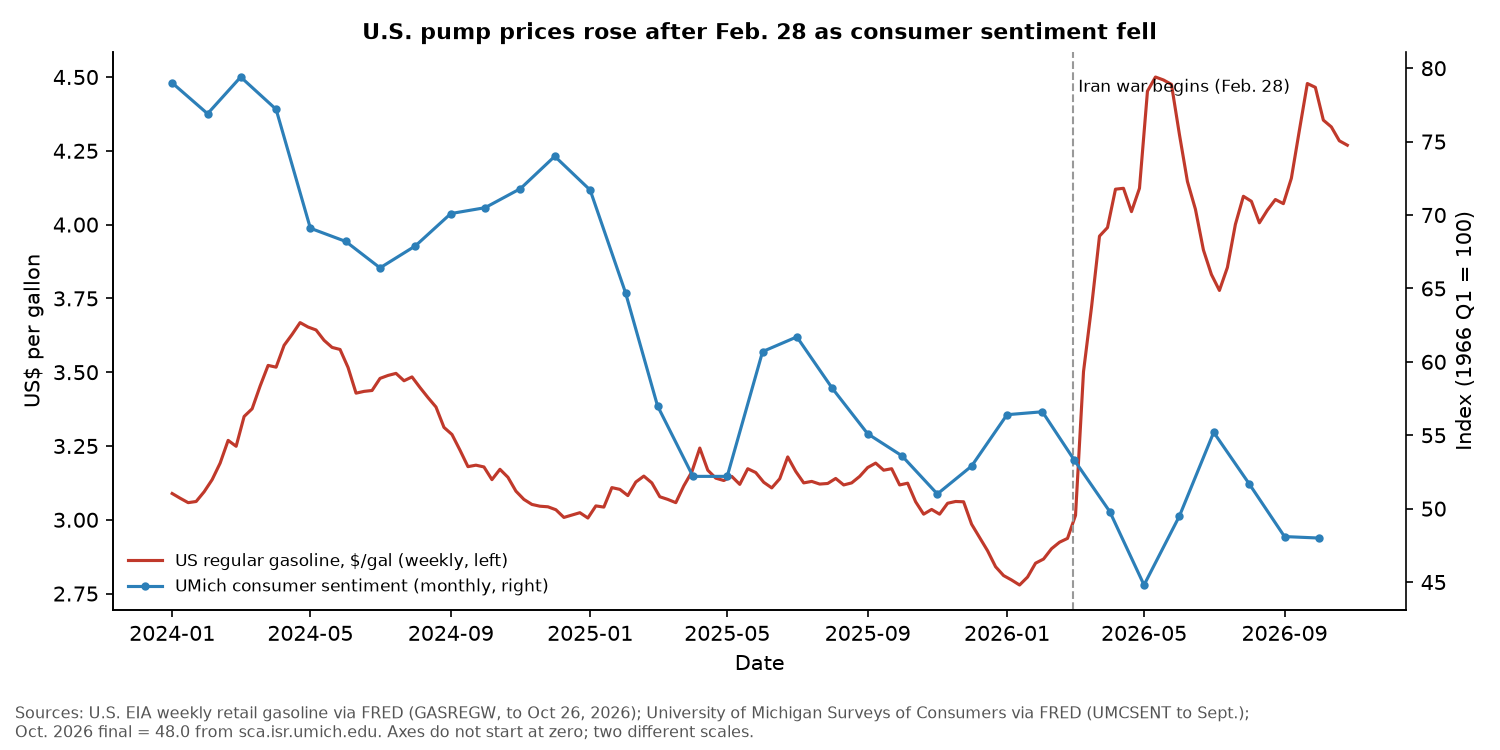
U.S. consumer sentiment stood at 48.0 in October (University of Michigan), near historic lows. In Michigan's midterm report, 40% of consumers mentioned fuel prices and more than one in eight cited the Iran conflict.
Canadians report the same pattern. The Bank of Canada's third-quarter consumer survey found spending plans "deteriorated from already weak levels." Spending intentions were weaker among households that expect the war in the Middle East to "significantly raise inflation." In a Numerator survey of 1,030 Canadian shoppers in March, dining out and takeout topped the list of things people were pulling back on, at 67%, followed by travel (48%) and large purchases (47%).
The strongest evidence for stocking up comes from stated intentions early in the war. In a March Omnisend survey of 1,000 Americans, conducted by Cint, "nearly 48% say they are more likely to buy items sooner because they expect prices to increase." The most common early purchases were pantry staples (58%) and household essentials (57%). Intentions are not purchases, and the sales data since then do not show a sustained surge.
What about gold, guns and gas lines?
Traditional fear trades are quiet too. Gold futures fell 6.87% in October and are down 13.31% for the year (Argaam). "Buy gold" searches are about a quarter of their January 2026 peak. Britain's Royal Mint said revenue from gold coin purchases rose 21% in July–September from the previous quarter (Kitco), a notable exception. NSSF-adjusted U.S. firearm background checks fell 2.3% year over year in September (NSSF via Shooting Wire). GasBuddy's Patrick De Haan attributed mid-October pump outages in Nebraska to one supplier's problems at four terminals, saying "there's plenty of fuel to go around" (Nebraska Public Media, Oct. 19).
Documented stockpiling is happening in Iran itself, where residents have been buying food and medicine for fear of renewed fighting (Al Jazeera, Sept. 29; AP via Los Angeles Times, Oct. 25).
What should Canadians watch next?
New retail figures (U.S. October data in mid-November; Canada's September data on Nov. 20), Costco's October sales and early-November card-spending trackers will show whether the search spike turned into purchases. Grocery inflation in Canada slowed to 1.7% in September while gasoline prices rose 27.8%, so any jump in grocery volumes would stand out.
Bottom line
The premise that North Americans are panic-buying before the Nov. 3 vote is not supported by the data available as of Nov. 2. People are searching for stockpiling advice, largely after British and Pentagon preparedness headlines, but spending data show households squeezed by fuel costs and trimming elsewhere. The late-October data due in coming weeks will be the real test.
This article is general information and is not investment advice.
Sources
- Google Trends: stockpile, emergency kit, prepper, buy gold (US, CA; weekly and daily, fetched Nov. 2, 2026) — Google · data
- Advance Monthly Retail Trade (Sept. 2026) series RSGCS, RSGASS, RSHPCS, RSAFS etc. — U.S. Census Bureau via FRED · government
- CPI food at home (CUSR0000SAF11) — BLS via FRED · government
- Retail trade sales by industry, Table 20-10-0056-01 — Statistics Canada · government
- Retail trade, August 2026 (The Daily, Oct. 23) — Statistics Canada · government
- Consumer Price Index, September 2026 (Oct. 19) — Statistics Canada · government
- Weekly U.S. regular gasoline price (GASREGW) — U.S. EIA via FRED · government
- Consumer sentiment (UMCSENT); October final 48.0 — University of Michigan · survey
- Gasoline Prices and Expected Consumer Spending (Oct. 9, 2026) — University of Michigan · survey
- Expected Outcomes and Economic Implications of Midterm Elections (Oct. 30, 2026) — University of Michigan · survey
- Consumer Checkpoint, October 2026 — Bank of America Institute · data
- Canadians keep s · data
- Canadian Survey of Consumer Expectations, Q3 2026 (Oct. 19, 2026) — Bank of Canada · survey
- The Impact of Geopolitical Conflict on Consumer Behaviour (Apr. 15, 2026; March survey) — Numerator Canada · survey
- Survey: 65% of Americans have already changed their spending due to Iran war fears (Mar. 17, 2026) — Omnisend · survey
- Costco reports September sales results (Oct. 7, 2026) — Costco · company
- Pentagon's FORTRESS initiative preps US bases for 90-day survival (Oct. 25, 2026) — Fox News · news
- Pentagon orders bases to plan for 90 days without the grid as Britain urges families to stockpile (Oct. 26, 2026) — Fortune · news
- Kit d'urgence de 72 heures: pourquoi les préfectures multiplient les appels — RTL · news
- Emergency kits — Government of Canada · government
- Gold closes below $4,000; posts weekly, monthly losses (Oct. 30, 2026) — Argaam · news
- Royal Mint sees record silver and platinum sales, renewed gold demand (Oct. 21, 2026) — Kitco · news
- NSSF-adjusted NICS background checks for September 2026 — Shooting Wire / NSSF · data
- Omahans report local gas outages, industry group says supply squeeze is worse than usual this year (Oct. 19, 2026) — Nebraska Public Media · news
- Iranians stock up on food and medicine as fears of new US fighting grow (Sept. 29, 2026) — Al Jazeera · news
- Iranians fear return to all-out war as U.S., Israeli elections approach (Oct. 25, 2026) — AP via Los Angeles Times · news
Newsletter
News. Context. What matters.
One essential briefing, written for people who would rather understand the story than scroll it.
Unsubscribe anytime. We don’t sell addresses.
Recommended

Business
Wall Street just punished Big Tech's AI spending spree — and Canadian portfolios felt it
The Nasdaq had its worst day since June as investors questioned trillion-dollar AI bets. Meta fell 8% after a $10-billion legal charge hit its earnings.

Business
Meta just beat on revenue and put its AI agent at 10 million users — then split its stock in a way that keeps Zuckerberg in charge
Third-quarter revenue jumped 26 per cent to US$64.6 billion on a 14 per cent rise in ad prices, but a US$9.89-billion legal charge dragged reported earnings down. The bigger story: a new class of nonvoting shares that lets Meta fund its AI buildout without touching Mark Zuckerberg's control.
Business
Tesla's profit fell 43% this quarter — but record Canadian deliveries helped save the story
Revenue held flat at $28.05 billion as margins got squeezed by AI and robot spending. The bright spots: FSD now rides along in more than 75% of North American deliveries, and Canada just set a record.