Canada
Carney cut immigration. Now he's hinting at turning the taps back on.
The 380,000-a-year plan, the 5% target, and the September signal nobody should ignore — Canada's immigration reset, explained.
Published: October 14, 2026 · Updated: October 14, 2026 · 3 min read
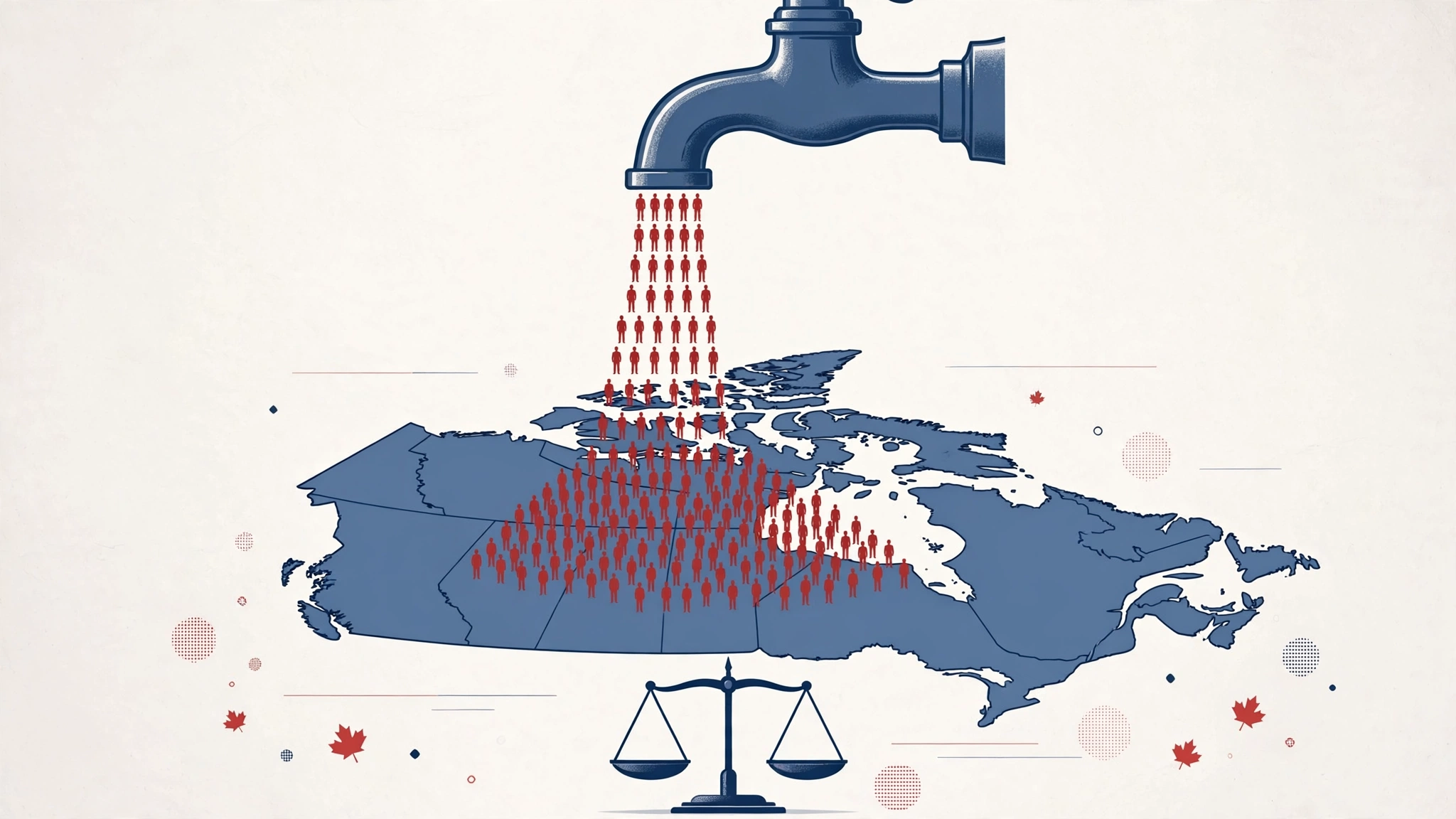
First, the honest headline: there is no brand-new October immigration policy. What exists is the 2026–2028 Immigration Levels Plan, released last November — the first under a Carney government — and a signal from the prime minister himself on Sept. 29 that the era of cuts may be ending. In a New York Times interview, Carney said the government is "getting the system under control" and the question is now "when do we resume some controlled increase in the population, which is the nature of Canada." No new targets were announced. But the 2027–2029 plan, legally due this November, will be the first document that could reflect a change — which makes the signal worth taking seriously.
So what is the actual policy? For 2026 through 2028, Canada will admit 380,000 permanent residents a year — flat. Of those, 63 per cent come through economic streams (rising to 64 per cent in 2027–28), 22 per cent through family reunification, and 13 per cent as refugees and protected persons. The sharper cuts are in temporary arrivals: 155,000 international students and 230,000 temporary workers a year — down roughly half and more than a third respectively from 2025 targets. The goal: shrink the temporary-resident stock to below 5 per cent of the population by the end of 2027, from 6.7 per cent today.
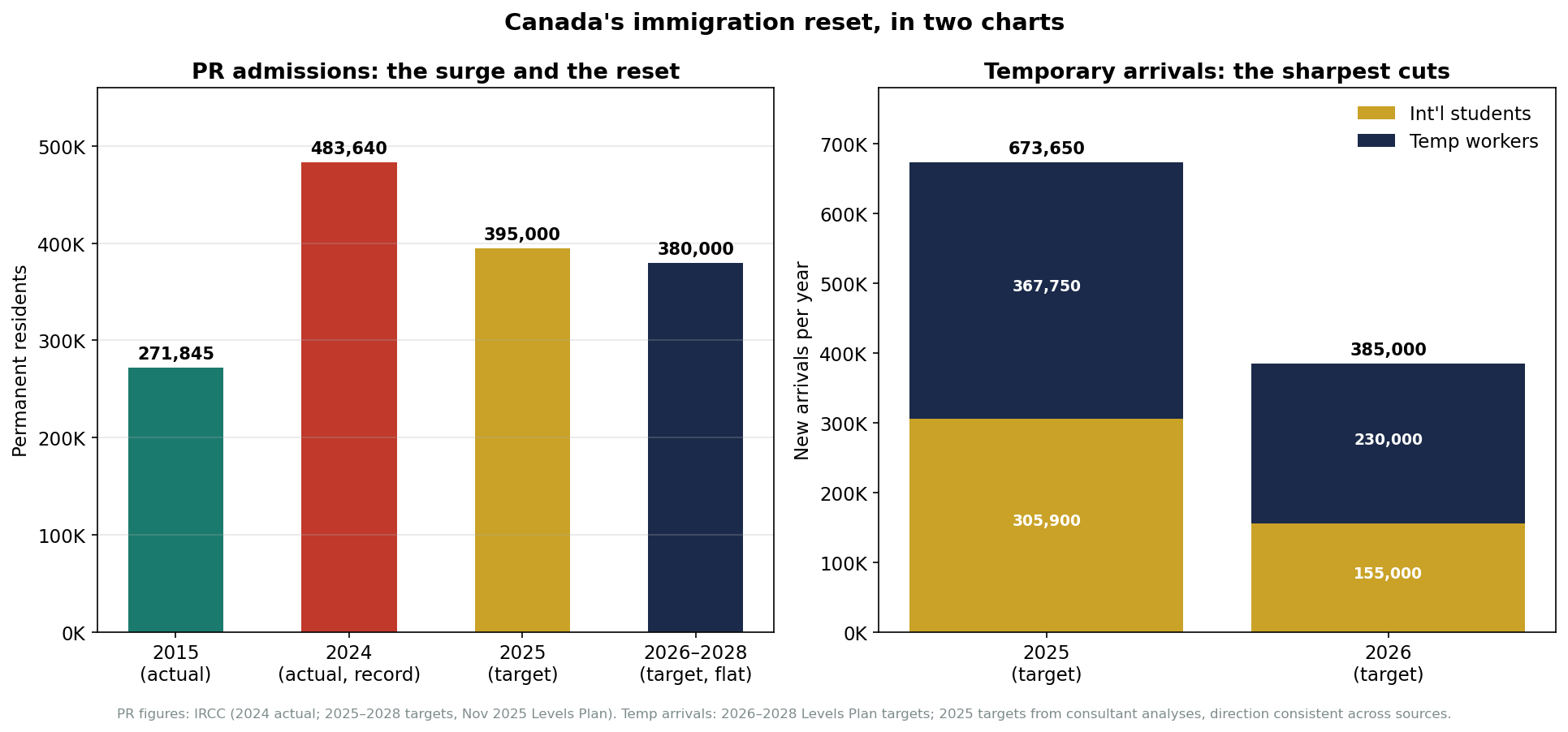
To understand the reset, look at the surge. Permanent resident admissions went from 271,845 in 2015 to a record 483,640 in 2024. The temporary-resident stock — students, workers, asylum claimants — ballooned from about 925,000 at the 2021 Census to 3.05 million by October 2024, roughly 7 per cent of the population. The turn began in 2024 with student caps; Carney's plan continued it, but with a distinct tilt: the economic share of PRs rises from 59 to 64 per cent. This is immigration as workforce strategy, not just population strategy.
The plan also contains a quiet revolution in who gets in. Up to 33,000 work-permit holders already in Canada will transition to permanent residence in 2026–27, and about 115,000 protected persons already here will be recognized as PRs over two years. IRCC's logic: in-Canada transitions are the "lowest-burden" immigration — people already housed, employed and paying taxes, adding no new housing demand. It's an elegant answer to the housing critique, and it explains the 2027–2029 question Carney is really asking: once the system is "under control," does the country need the taps turned back up?
The reactions split exactly where you'd expect. Conservative immigration critic Michelle Rempel Garner called Carney's "controlled increase" talk "irresponsible," arguing targets should go "way down" on housing, health-care and jobs grounds. The C.D. Howe Institute's immigration council — which includes former Alberta premier Jason Kenney — recommended continued reductions over the next three years. And a Globe and Mail column argued the cuts haven't gone far enough: the 5 per cent temporary-resident target is "well behind schedule," it said, proposing 3 per cent instead and an end to the low-wage temporary foreign worker program.
What does it mean for you? If you're a prospective immigrant, the Express Entry pool holds 229,456 candidates competing for draws like Tuesday's — 752 provincial-nominee invitations at a CRS cutoff of 772, the largest PNP draw since June. If you're an employer, temporary foreign workers just got much harder to hire. If you're a university, your international-student pipeline was roughly halved. And if you're a renter, note this: population growth fell to 0.5 per cent in the year to July — the smallest increase since 1944–45 — and non-permanent residents just posted their largest drop since 1971–72. The housing pressure valve is real, and it's already turning.
My take: the debate is really about sequencing, and Carney knows it. He bet that cutting first and asking questions later was the only politically survivable path after the Trudeau-era surge — and the numbers suggest the system is indeed stabilizing. But he's also linked Canada's economic softness to lower immigration, which means the pressure to turn the taps back up is coming from inside his own logic. The November levels plan will tell us which Carney wins: the disciplinarian or the growth-seeker. Watch that document — not the interviews — because in immigration policy, only the numbers are real.
What matters
What happened
The operative policy is the Nov 2025 Levels Plan: 380,000 PRs/year flat through 2028, temporary arrivals sharply cut, temp-resident stock target below 5% by end 2027. On Sept. 29, Carney signaled a future "controlled increase" may come.
Why it matters
Immigration is Canada's population strategy — and the fiercest debate in Canadian politics. The November 2027–2029 plan will show whether cuts continue or reverse.
What we know
PRs peaked at 483,640 in 2024; temp arrivals were roughly halved; in-Canada transitions (33K workers, 115K protected persons) are the plan's quiet core. Figures from IRCC and StatCan; there is no new October policy — the signal is forward-looking.
What we don’t
Whether the signal becomes targets; how low the temp-resident stock actually falls; how the opposition and provinces react to any increase.
What’s next
The 2027–2029 Immigration Levels Plan is legally due this November — the first that could reflect Carney's "controlled increase" signal.
Sources
HousingopinionCarneyimmigrationExpress Entrypopulation
Newsletter
News. Context. What matters.
One essential briefing, written for people who would rather understand the story than scroll it.
Unsubscribe anytime. We don’t sell addresses.
Recommended

Canada
Ottawa tables bill to let Canadians request assisted dying in advance — and drops the mental-illness expansion
Bill C-41 would let adults diagnosed with an incurable illness that will take away their decision-making capacity consent to medical assistance in dying in advance, while the government says it will not proceed with eligibility based solely on mental illness.
Canada
Trump says a Canada tariff deal is coming 'pretty soon' — but offers no terms
At a Michigan border rally Sunday, the U.S. president predicted the trade dispute would be settled soon while repeating his claim Canada has been "ripping off" the U.S. — and Ottawa did not immediately respond.
Canada
B.C. Conservatives win majority government — and David Eby is stepping down as NDP leader
CTV News declared a Conservative majority Saturday night as interim leader Lorne Doerkson's party surged to a commanding lead, ending nine years of NDP government and giving B.C. its first Conservative government in nearly a century.